The Security Model
The platform’s layers can be read as an operating system. They can also be read as concentric defenses across the whole stack — cloud, cluster, container, and code — and that’s the reading here. A security doc that lists only what works is a wall of green checkmarks, which is exactly what an attacker hopes you’ll write, so this one stays honest about the gaps.
The question
Section titled “The question”Most of the platform is framed around shipping software. Flip it around and take the adversary’s view: if
someone wanted to steal alpha’s data or take over the cluster, what actually stops them at each level,
and where are the holes we already know about? A model that defends one layer — workloads, say — while
staying quiet about the cloud account, the cluster, the application code, and the things we haven’t built
yet is a comfort blanket, not a security model. So this one goes top to bottom and keeps a running tally
of what’s missing. That tally moves as the posture matures. A security posture is a state, not a monument.
Defense in depth, in two dimensions
Section titled “Defense in depth, in two dimensions”Security here isn’t a feature bolted on. It’s a property of the layers, and it works because the layers are independent. The reason is structural (traced in How the Platform Fits): almost every control plane is also a security control. The admission gate that enforces resource limits also rejects unsigned images; the Pod Identity that hands out AWS credentials also refuses to mint long-lived keys; the account boundary that contains a deployment’s blast radius also contains an attacker’s. We never built a separate “security system” — security falls out of the layering. Defense in depth means many independent walls, arranged so an attacker must defeat all of them in sequence.
The walls, outermost to innermost — each an independent slice a request or workload must clear before it
can reach alpha’s data. The standard way to organize them is the
4 C’s of cloud-native security — concentric
layers, outermost first:
Cloud → Cluster → Container → Code. Each layer is secured on top of the one outside it. Weak cloud security can’t be rescued by strong container security; the layers compound, they don’t substitute.
There’s a second axis, orthogonal to the first: time. The same concern is defended at three moments — shift-left (caught in CI, before it exists), at admission (blocked at the cluster door), and at runtime (detected while running). Depth and time — a grid, not a line.
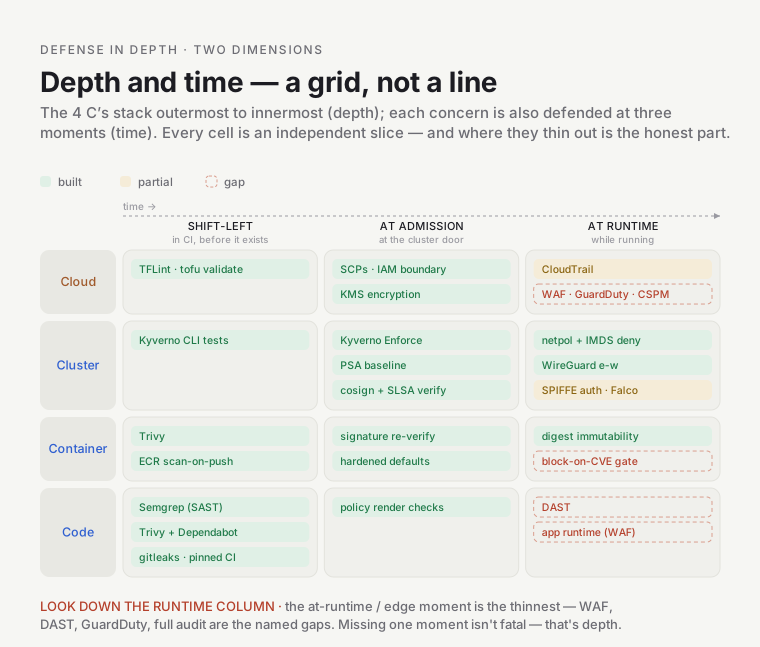
The mental model for why independent layers matter is the Swiss cheese model (James Reason, safety engineering): each layer is a slice with holes — no control is perfect — but the holes sit in different places, so a threat only lands if the holes align across every slice at once. You don’t build security by finding one flawless slice; you build it by stacking imperfect slices whose holes don’t line up. Where it breaks: real cheese holes are fixed; ours move — a misconfiguration can suddenly align holes that were safely offset yesterday. That’s why the honest gaps register near the end carries as much weight as the walls themselves.
Below, each layer is walked with its defenses tagged built, partial, or gap (designed or absent).
Cloud — the AWS layer
Section titled “Cloud — the AWS layer”The outermost wall, and the strongest, because it’s enforced below anything we run — by AWS itself, not by software we operate.
- Account isolation + SCPs (built) — preprod, prod, platform, and mgmt are separate AWS accounts. An attacker who completely owns preprod cannot reach prod — not “shouldn’t,” can’t: the account is AWS’s hardest isolation boundary (separate IAM, billing, resources), and cross-account access is deny-by-default. On top of that, Service Control Policies make whole categories of action impossible org-wide — a guardrail even a compromised account-admin can’t step over, because it’s enforced at the organization root above the account.
- Least-privilege IAM + a permissions boundary (built) — every role holds the minimum it needs. And every environment IAM role is additionally capped by a permissions boundary — a distinct AWS mechanism worth understanding: a policy can’t grant more than the boundary allows, no matter what gets attached later. So even if an attacker could edit an environment’s role policy, the boundary is an outer fence they can’t move. Grant-time least-privilege plus a hard ceiling. (An SCP and a permissions boundary both limit what a role can do, but at two altitudes: the SCP applies to a whole account from above it, the boundary is attached to an individual role as a ceiling on its own policies. Both have to be passed.)
- Encryption + keys (built) — KMS-managed keys throughout; data is encrypted at rest, including EKS Secrets envelope-encrypted in etcd (so a raw etcd read yields ciphertext, not secrets).
- Audit (partial) — CloudTrail records API activity on the secrets/KMS path. But cloud-native threat detection is a gap: no GuardDuty (behavioral anomaly detection), no AWS Config / Security Hub (continuous posture / CSPM), no Inspector (resource vuln scanning), no Macie (sensitive-data discovery). We have the isolation walls; we don’t yet have the cloud-level alarms — a deliberate cost trade-off, since these are usage-priced and can get expensive. Tracked, not forgotten.
- Edge protection (gap) — no AWS WAF and no managed DDoS/Shield posture. Public ingress is TLS’d and hostname-scoped, but nothing inspects request content for attack patterns (injection, path traversal, bad bots). This is the same hole that shows up at the Code layer, seen from outside.
Cluster — the Kubernetes layer
Section titled “Cluster — the Kubernetes layer”- Private API (built) — the cluster API is private-only, reached over Tailscale, never the public internet. The single most-attacked surface of a Kubernetes cluster simply isn’t on the internet to attack.
- RBAC (built) — least-privilege, per-team; the platform-engineer access model itself is read-and-operate, not author — even operators don’t hold standing authority to rewrite the cluster; that goes through GitOps.
- Pod Security Admission (built) — the PSA baseline floor sits underneath Kyverno as a native Kubernetes backstop. This is defense-in-depth within one layer: even a Kyverno outage or a policy gap can’t admit a wildly privileged pod, because PSA is a second, independent slice. It’s the same logic as the account boundary sitting under the network policy — two slices, holes offset.
- Admission control — Kyverno (built, Enforce) — the policy engine on the cluster door, rejecting non-compliant workloads on preprod and platform (wrong registry, missing limits or probes, disallowed hostnames, privileged containers). Policy-as-code: the rules that used to live in a reviewer’s head are executable and identical every time.
- Network policy — Cilium (built) — pod-to-pod traffic is default-restricted, so a compromised pod
can’t freely roam the cluster. And pods are explicitly denied egress to the instance-metadata service
(IMDS) (built, live on preprod) — a
deny-imds-egresspolicy in every environment namespace closes a classic credential-theft / SSRF path, so IMDS protection doesn’t rest solely on the node’s IMDSv2 hop-limit. - CIS benchmark scanning (built, preprod) — kube-bench runs the CIS EKS Benchmark on a schedule and surfaces findings, so cluster hardening is measured against a standard rather than assumed. The scan is live; acting on findings and hardened-AMI adoption are the remaining half.
- Runtime detection — Falco (partial) — watches syscalls on the environment clusters and alerts on suspicious behavior (a shell spawned in a container, a read of a sensitive path). Live on preprod; coverage and alert-tuning still maturing — and it’s detection, not prevention.
- East-west encryption + mutual auth — Cilium WireGuard + SPIFFE/SPIRE (built) —
the east-west (service-to-service) half of zero trust.
Pod-to-pod traffic is transparently encrypted on the wire (WireGuard, live on both clusters — no app
changes), and Cilium mutual authentication with an embedded SPIRE issues a per-workload SPIFFE identity,
so services cryptographically prove who they are to each other rather than being merely “restricted by
policy.” Live as a showcase on preprod: the
storefront → checkoutcall withinalpha-shopis SPIRE-mutually-authenticated (AUTH TYPE=spire), a cross-team impostor is denied. Fleet-wide, tier-gated enforcement is the remaining half. - Gaps — EKS API audit logging isn’t fully on (a cost trade-off — the logs are CloudWatch-only and high-volume), leaving cluster forensics thin. Hardened-AMI adoption is backlog.
Container — the image & workload layer
Section titled “Container — the image & workload layer”- Signed + attested images (built) — every image is cosign-signed and carries SLSA provenance, and Kyverno re-verifies at admission — trust is checked at the moment of use, not taken on faith from the registry. This defeats image substitution (swapping a malicious blob under a trusted name).
- Vulnerability scanning (built) — Trivy scans dependencies and Dockerfile config in CI, and ECR scan-on-push scans the built image in the registry, so a known CVE is flagged before and after it lands.
- Hardened runtime context (built) — Kyverno mutates in the safe defaults so developers can’t forget
them: drop all Linux capabilities, no privilege escalation,
seccomp: RuntimeDefault, non-root where declared; regulated tiers additionally forcerunAsNonRoot+readOnlyRootFilesystem. The safe container is the default container. - Immutability (built) — deploys are pinned to an image digest, not a mutable tag — you can’t swap
what
:latestpoints at under a running service. - Gaps — base-image currency (auto-rebuild on an upstream CVE) and distroless/minimal-base enforcement are partial, and there’s no end-to-end “block deploy on critical CVE” gate yet — so a known-vulnerable image can still technically deploy.
Code — the application layer
Section titled “Code — the application layer”Where OWASP Top 10 risks live — injection, broken access control, XSS, and friends. This is the layer most dependent on the app team, so the platform’s job is to hand them strong shift-left tooling that runs automatically.
- SAST — Semgrep (built) — static analysis runs in CI, catching a class of code-level security bugs (a slice of the OWASP Top 10) before merge; results published as SARIF.
- SCA — Trivy + Dependabot (built) — dependency vulnerability scanning in CI, plus automated dependency-update PRs so the fix arrives as a reviewable change.
- Secret scanning — gitleaks (built, live) — a fail-closed CI job (plus a pre-commit hook) scans full history for committed credentials, with a tight allowlist for the deliberately committed SOPS ciphertext. So “someone pasted a key into a file” is caught by a scanner, not just by review.
- CI/CD supply-chain hardening (built) — GitHub Actions are pinned to SHAs and installed with checksum
verification; fail-closed governance gates guard every registry/roles/people/teams change;
mainis protected, and changes are reviewed. The pipeline itself is a hardened surface. - Policy shift-left (built) — the app CI validates each overlay builds namespace- and host-agnostic and
product-scoped (a
kubectl kustomizerender plus checks for hardcoded namespaces, host placeholders, and cross-product images), so obvious violations surface in the PR. Kyverno enforces at admission; the Kyverno CLI runs in CI over the policy module’s own test suite, keeping the rules honest. - Gaps — no DAST (dynamic/running-app testing), and — tying back to Cloud — no WAF to blunt OWASP-class attacks against running apps at the edge. App-layer runtime defense (as opposed to the strong shift-left tooling above) is the thinnest part of the model today.
Security across time — shift-left, enforce, detect
Section titled “Security across time — shift-left, enforce, detect”Step back from the layers and look along the timeline — the time axis of the grid above. The platform defends the same concerns at three moments, and the earlier it catches something, the cheaper the fix:
- Shift-left (in CI, before it exists): Semgrep, Trivy, gitleaks, the Kyverno CLI, TFLint,
tofu validate— a problem caught here never reaches a cluster. - At admission (at the door): Kyverno + PSA + signature verification — a problem that slipped past CI is blocked before it runs.
- At runtime (while running): Falco + network policy (incl. the IMDS deny) + least-privilege scope — a problem that got in is detected and contained.
Catch early, enforce at the door, detect what slips past. Missing any one moment isn’t fatal — that’s the point of depth — but the gaps register shows the runtime moment (WAF, DAST, full audit) is still our thinnest.
Watch the layers hold — a concrete threat
Section titled “Watch the layers hold — a concrete threat”Walk a real one. An attacker compromises a dependency shop pulls in — malicious code in a library
shop’s own devs merge unknowingly.
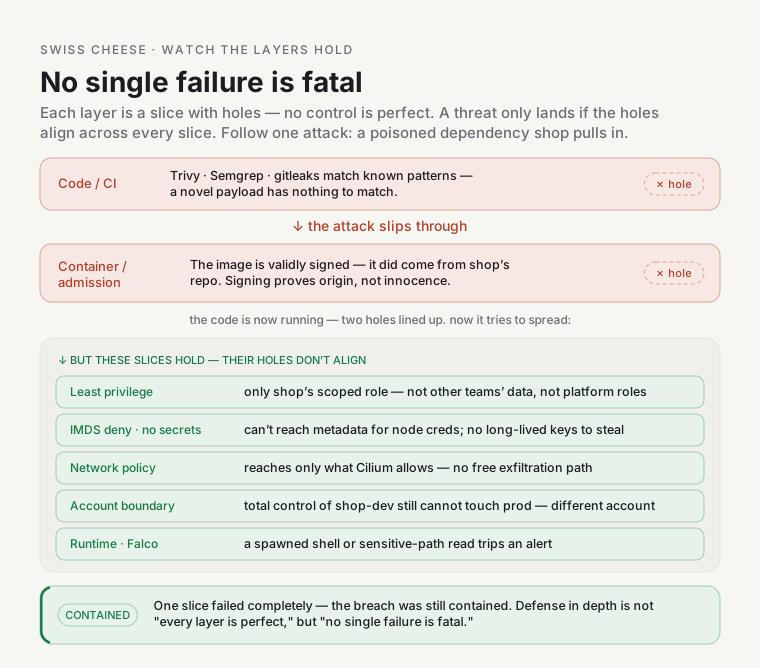
- Code / CI — a partial catch. If the poisoned dependency has a known CVE, Trivy flags it in CI and the PR fails — caught, shift-left. But if it’s a novel or deliberately-hidden payload, Trivy, Semgrep, and gitleaks have nothing to match, and it passes. This slice has a hole for a targeted supply-chain attack — pretending otherwise would be the dishonest kind of security.
- Container / admission — it passes. CI builds and signs the image; the signature is genuinely valid
(it did come from
shop’s repo). Kyverno’s signature check passes, because signing proves origin, not innocence. The malicious code deploys. One slice’s holes have lined up. - The other slices hold. Now the code tries to steal data and spread:
- Least privilege / Pod Identity: it has only
shop‘s scoped AWS role — its own bucket, not other teams’ data, not platform roles. - IMDS deny + no standing secrets: it can’t reach the metadata service to harvest node credentials, and there are no long-lived keys baked into the image to steal.
- Network policy: it can only reach what Cilium allows — no free exfiltration path.
- Account boundary: total control of
shop-devstill cannot touch prod — different AWS account. - Runtime (Falco): spawning a shell or reading a sensitive path trips an alert.
- Least privilege / Pod Identity: it has only
One slice failed completely; the breach was still contained, because least privilege, the IMDS deny, network policy, account isolation, and runtime detection are independent walls whose holes didn’t align. That is defense in depth — not “every layer is perfect,” but “no single failure is fatal.”
The two principles underneath everything
Section titled “The two principles underneath everything”- Least privilege — every identity, human or workload, gets the minimum it needs, most of it only
briefly. A poisoned
shoppod can hurtshop, not the platform. (NIST.) - Zero standing trust — nothing is trusted by default or permanently: no long-lived keys (Pod Identity is short-lived), no standing admin (temporary-power expires), no unsigned image, no implicit network reach, no imperative cluster access. Earned, scoped, time-boxed — the instinct of NIST Zero Trust (SP 800-207).
The gaps register — what we do not claim
Section titled “The gaps register — what we do not claim”The most important section. A posture you can trust is one that names its own holes. As of today:
| Layer | Gap | Why it matters |
|---|---|---|
| Cloud | No WAF / managed DDoS | No edge inspection of requests for OWASP-class attack patterns |
| Cloud | No GuardDuty / Config / Security Hub / Inspector / Macie | Isolation walls exist, but no cloud-level threat detection or continuous posture/CSPM (a cost trade-off) |
| Cluster | East-west mutual auth not yet fleet-enforced — encryption is fleet-wide; mutual auth (SPIFFE/SPIRE) is a preprod showcase | Every service can be cryptographically authenticated (proven on alpha-shop’s storefront↔checkout), but authentication.mode: required policies aren’t yet applied fleet-wide per tier |
| Cluster | EKS API audit logging not fully on | Thin cluster-API forensics after an incident (CloudWatch cost trade-off) |
| Cluster | No hardened-AMI program; kube-bench findings not yet remediated | The CIS scan now runs, but node hardening isn’t complete |
| Container | No end-to-end block-on-critical-CVE gate; base-image currency partial | A known-vulnerable image can still deploy |
| Code | No DAST; app-layer (OWASP) runtime defense thin | Running-app vulnerabilities aren’t actively tested or shielded |
| Cross-cutting | Secrets rotation not automated | Secrets are encrypted + isolated, but rotating them is manual |
| Cross-cutting | No SIEM / central security-event aggregation | Signals exist (SARIF, CloudTrail, observability) but aren’t correlated in one place |
| Cross-cutting | No pentest / red-team program; compliance evidence aspirational | Controls aren’t adversarially validated or attested |
| Cross-cutting | Backup / DR partial — no tested restore/DR drills, no cross-region copy, RTO/RPO unvalidated | CNPG databases are backed up (WAL + PITR to S3), but recovery hasn’t been rehearsed and non-CNPG data isn’t covered |
None of these are secrets — they’re tracked and prioritized, and naming them is the maturity signal. A platform that claims perfect security is telling you it hasn’t looked hard enough.
Where this model comes from
Section titled “Where this model comes from”Textbook, deliberately:
- The 4 C’s (Cloud/Cluster/Container/Code) — Kubernetes security overview and the CNCF Cloud Native Security Whitepaper.
- App-layer risks — the OWASP Top 10.
- Defense in depth · least privilege · zero standing trust — NIST · least privilege · NIST Zero Trust (SP 800-207).
- Supply-chain integrity — SLSA + Sigstore/cosign.
- Cloud foundation — AWS Security pillar.
- The Swiss cheese model of layered defense — James Reason, safety engineering.
Go deeper
Section titled “Go deeper”- The same layers as an operating system: How the Platform Fits. The signing and admission walls in motion: The Life of a Deployment.
- As full modules: Policy & admission · Identity & access · Supply chain (built) · (coming — inventory) the honest Compliance & regulated workloads placeholder.
- The canon: 4 C’s / K8s security · CNCF Cloud Native Security · OWASP Top 10 · NIST Zero Trust · SLSA.