Learn: Foundations — the account model & SCPs (deep dive)
An AWS account is the platform’s hard isolation boundary, and Service Control Policies are the law
above it. This deep dive opens that box: how the boundary is actually enforced by AWS, how an SCP
differs from every IAM policy you’ve written, why a brand-new automation mysteriously 403s on its
first apply, and the role chain that lets a single operator reach across the walls without tearing
them down. One hard idea, traced through the real policy code and the live org.
Everything else rests on this being true. The Environment API isolates tenants with Kubernetes namespaces; Kyverno rejects bad manifests at admission; IAM scopes a pod’s cloud access. Every one of those is a soft boundary — enforced by software, inside one trust domain, defeatable by one misconfiguration. This layer is the one hard boundary underneath them, the thing that still holds when a soft one fails.
The mechanism in one sentence
Section titled “The mechanism in one sentence”An AWS account is a separate security principal that AWS itself enforces; an SCP is a permission ceiling the AWS Organization pins above that account; your effective permission is the intersection of the ceiling and your IAM grant — and a narrow, auditable role-assumption is the only bridge across.
Principal, ceiling, intersection, bridge. The rest of this is those four words made concrete.
Start from the live estate
Section titled “Start from the live estate”Everything below is checkable. Here is the whole account estate, live:
$ AWS_PROFILE=management aws organizations list-accounts --query 'Accounts[].Name'[ "Test", "<the management account>", "Preprod", "Prod", "Platform"]Five accounts, and each is a distinct role in the design:
- The management account — governance only. It owns the AWS Organization, holds the org-wide SCPs,
and runs the Terraform state backend (the S3 state bucket +
terraform-locksDynamoDB table). Almost no workloads. And SCPs do not apply to the management account — so it deliberately holds as little as possible. - The platform account — the hub: the platform EKS cluster, ArgoCD, the Transit Gateway hub, DNS, ECR, observability, CI runners. Everything the environments consume.
- preprod and prod — the spokes, running the environment clusters and tenant workloads.
- Test — a Terratest sandbox, where CI creates and destroys real infrastructure without touching anything real.
The estate as a tree: the Org root, the accounts by role, the SCP ceiling over the member accounts (never the management account), and the role bridge an operator crosses:
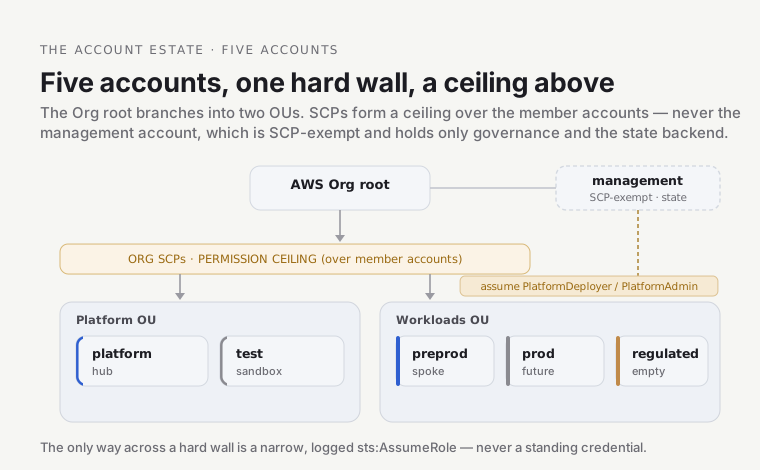
The accounts hang off a deliberate two-branch tree. Live:
$ aws organizations list-organizational-units-for-parent --parent-id <root>[ "Workloads", "Platform" ]
$ aws organizations list-organizational-units-for-parent --parent-id <workloads-ou>[ "Prod", "Preprod", "Regulated" ]
So the tree is a Platform OU holding {Platform, Test}, and a Workloads OU holding
{Preprod, Prod, Regulated} — where Regulated is an empty OU held open for future HIPAA/PCI
workloads (it exists so that turning on a compliance regime later is an attach, not a restructure).
The management account sits at the root, in no OU at all — both because SCPs can’t govern it anyway,
and because putting it in an OU would only confuse which policies apply.
Why the account is the hard boundary
Section titled “Why the account is the hard boundary”The metaphor: namespaces are locked rooms in one house — the homeowner holds every key; accounts are separate buildings on separate plots. Here’s the enforcement reason under it.
An AWS account is a separate security and billing principal enforced by AWS itself. A credential minted
in preprod names preprod’s account number in every ARN it can address. It cannot address a resource
in prod — not “shouldn’t,” can’t — because the resource ARN carries a different account number and
AWS’s own authorization refuses it unless an explicit, logged cross-account role trust says otherwise.
There is no “the wildcard matched the neighbour” failure, because there is no shared namespace to
wildcard across. Blast radius is capped by construction: a runaway automation or a fat-fingered
destroy in preprod physically cannot reach prod’s state, secrets, or data. Compare a namespace, where
a single cluster-admin slip crosses every namespace in the cluster at once.
That is the whole reason the estate is split five ways instead of run as one big account with careful IAM: IAM is a soft wall you maintain; the account boundary is a hard wall AWS maintains for you.
SCPs: the ceiling, dissected
Section titled “SCPs: the ceiling, dissected”SCPs operate above the account. An IAM policy grants, and is enforced inside an account by that account’s own admins (who can rewrite it). A Service Control Policy is the opposite in three ways:
- It’s a ceiling, not a grant. An SCP never gives a permission — it only removes one from the
maximum. The actual granting is the implicit
FullAWSAccesspolicy AWS attaches everywhere (it shows up in the live list below, next to our seven). SCPs carve that maximum down. - It’s enforced from above the account, by the AWS Organization from the management account — so even the member account’s root user can’t escape it.
- Your effective permission is the intersection of every SCP in the chain from root to your account and your IAM policy. Every layer can only subtract. This is why SCPs are “deny-only in practice”: there is no allow-override lower down.
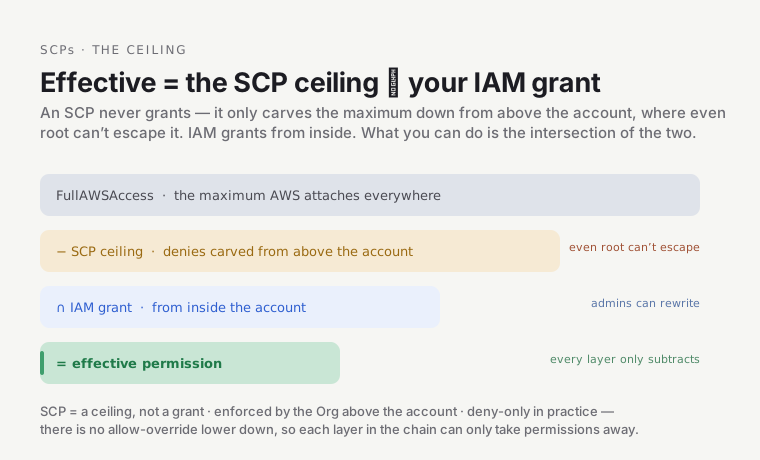
Here is one real statement, verbatim from
scps.tf, the
S3-encryption rule inside enforce-encryption:
statement { sid = "DenyUnencryptedS3Uploads" effect = "Deny" actions = ["s3:PutObject"] resources = ["*"] condition { # Null test with "true" = deny when the SSE header is ABSENT (forces explicit encryption) test = "Null" variable = "s3:x-amz-server-side-encryption" values = ["true"] }}The Null/"true" inversion looks backwards, so read it carefully: deny PutObject whenever the
server-side-encryption header is null (absent). Not “encrypt for you” — refuse the upload unless the
caller explicitly asked for encryption. This is the exact rule that bit a real app in the
self-service resources work: an SDK client that didn’t set
the SSE header got a flat AccessDenied, and no amount of IAM inside the account could fix it, because
the deny lives above the account. Encryption here isn’t a best practice you remember; it’s a law you
can’t break.
The org carries seven of these (plus an optional eighth), verified live:
$ aws organizations list-policies --filter SERVICE_CONTROL_POLICY --query 'Policies[].Name'[ "protect-security-services", "enforce-encryption", "FullAWSAccess", "baseline-guardrails", "restrict-iam-users", "protect-data-and-network", "deny-regions", "require-tagging" ]Their jobs, briefly: baseline-guardrails (can’t leave the org, root-user lockdown, protect
OrganizationAccountAccessRole, no region/password-policy changes); protect-security-services (nobody
can stop CloudTrail, Config, GuardDuty, Security Hub, Access Analyzer, or delete VPC Flow Logs — you can’t
blind the auditors); enforce-encryption (EBS/RDS/S3 encryption, protect KMS keys, force IMDSv2);
deny-regions (only us-east-1 / us-west-2, with global-service and Bedrock-inference exemptions);
protect-data-and-network (block S3 public-access changes, default-VPC creation, external RAM sharing,
backup deletion — and DenyTeamTagTampering); require-tagging (Environment/ManagedBy/Owner must
be set at creation); restrict-iam-users (no IAM users or access keys — force federation). The eighth,
hipaa-eligible-services, is an off-by-default service allowlist waiting for the Regulated OU.
Two of the eight enforce the platform’s ownership model, and they’re worth calling out because they seem minor and aren’t:
statement { sid = "DenyTeamTagTampering" effect = "Deny" actions = ["ec2:CreateTags", "ec2:DeleteTags", "ecr:TagResource", "ecr:UntagResource", "iam:TagRole", "iam:UntagRole", "secretsmanager:TagResource", "secretsmanager:UntagResource"] resources = ["*"] condition { test = "ForAnyValue:StringEquals" variable = "aws:TagKeys" values = ["Team"] } condition { test = "ArnNotLike" variable = "aws:PrincipalArn" values = concat(local.exempt_role_arns, ["arn:aws:iam::*:role/aws-service-role/*"]) }}The Team tag is how the whole domain model attributes a resource to
its owning team. If anyone could rewrite that tag, per-team attribution — and the ABAC that rides on it —
would be forgeable. DenyTeamTagTampering makes the tag immutable except for a short list of trusted
principals. That’s the deep reason ownership on this platform is un-spoofable, not merely conventional.
The exempt-role pattern — and why new automation 403s
Section titled “The exempt-role pattern — and why new automation 403s”Look again at the last condition in every deny statement above:
condition { test = "ArnNotLike" variable = "aws:PrincipalArn" values = local.exempt_role_arns}Each deny says “…unless the calling principal is on the exempt list.” That list is the escape valve for the handful of roles that legitimately must do the forbidden thing — the ones that set governance tags on resources they create, or run the applies that build the estate. Live, the exempt set is (the org unit):
exempt_roles = [ "OrganizationAccountAccessRole", "github-actions-terratest", "PlatformDeployer", "crossplane-ecr-provisioner", "crossplane-provisioner-*", "platform-use1-eks-karpenter-*", "preprod-use1-eks-karpenter-*",]PlatformDeployer must be here or every Terragrunt apply would trip require-tagging on the first
resource it creates. Karpenter is here because it tags the nodes it launches (via the launch template);
Crossplane is here because it Team-tags the ECR repos and IAM roles it provisions. Note the deliberately
anchored names — platform-use1-eks-karpenter-*, not a leading-wildcard *-karpenter-* — so an unrelated
role that merely contains “karpenter” can’t inherit the exemption. That precision was a security-audit
finding, not an accident.
This is the single most common way the account model surprises a platform engineer:
A brand-new automation role gets a mysterious
AccessDeniedon a tagging, region, orRunInstancesaction on its very first run. It is almost never an IAM gap. It is hitting an SCP from above the account, and the role isn’t onexempt_roles. No IAM policy you add inside the account can fix it — the fix is an explicit exemption at the org level (a one-line addition to that list, applied from the management account).
This is the mall fire-code vs. store rules metaphor made operational: the store manager (an in-account admin) can write any staff rule she likes, but she cannot vote to disable the sprinklers, because the fire marshal (the management account) enforces the fire code from outside. Where the metaphor breaks: a real fire code is uniform for everyone; an SCP has a named exemption list, so it’s more like a fire code with a short roster of licensed pyrotechnicians who are permitted, on file, to light the controlled flames.
The IAM role model — who may do what, and the bridge across accounts
Section titled “The IAM role model — who may do what, and the bridge across accounts”SCPs set the ceiling; IAM roles are the grants that operate underneath it. Four purpose-built roles carry the whole platform:
| Role | Lives in | Grants | The point |
|---|---|---|---|
| PlatformDeployer | platform, preprod, test | AdministratorAccess |
The apply identity. Terragrunt providers assume it; it’s SCP-exempt. Machine, never a human’s interactive role. |
| PlatformAdmin | platform, preprod | ReadOnlyAccess + explicit Denies on secret/data exfil + SSM-bastion scope |
Operate, not author. kubectl uses it: debug/exec/drain/restart, but no create, no cluster-admin, no secret values. |
| TerraformStateAccess | management | inline S3 (state bucket) + DynamoDB (terraform-locks) only |
The state identity. Assumed by the operator’s management SSO session (in parallel with PlatformDeployer, not chained under it) to read/write S3 state + the DynamoDB lock — matching the bridge diagram below. |
| OrganizationAccountAccessRole | all accounts | full admin | Break-glass only. SCP-exempt, and itself protected by the ProtectOrganizationRole SCP statement. |
| DeveloperAccess-<team> | preprod (design) | namespace-scoped kubectl | Designed, not built. The Environment Composition emits only the in-cluster RoleBinding; the per-team IAM role + EKS access entry aren’t provisioned. Use platctl kubeconfig / PlatformAdmin today. (A grep will turn up a generic DeveloperAccess role live in the platform account — assumable by SSO PowerUser/Admin holders — but that’s a separate generic role, distinct from the per-team paved path described here; preprod has no DeveloperAccess role live.) |
The key split is PlatformDeployer vs. PlatformAdmin. The role a human’s kubectl uses carries no
standing authoring power — you can operate the running platform all day and still not be able to create a
resource by hand. Authoring flows only through the pipelines (Terragrunt via PlatformDeployer, Kubernetes
via ArgoCD). Even the people who run the platform hold no standing power to
rewrite it; that’s the security model’s whole posture in one pair of roles.
The bridge across the hard walls: an operator never has standing credentials in a spoke account. The chain, on a routine apply, is:
aws sso login --profile management (a human SSO session in the management account) │ ├─ assume TerraformStateAccess → read/write S3 state + DynamoDB lock (in management) │ └─ assume PlatformDeployer @ target → make every AWS API call in preprod/prod/platformYou can see the second hop generated right in
root.hcl — every unit’s AWS provider is
written with assume_role { role_arn = "arn:aws:iam::${account}:role/PlatformDeployer" }, and Terragrunt only
performs the assume when the caller’s account differs from the target (so an in-VPC CI runner already in the
platform account doesn’t needlessly hop — unless TG_FORCE_DEPLOYER=1 makes it a faithful stand-in). Each
hop is a distinct, logged sts:AssumeRole. That’s the well-guarded bridge: the only way across the account
wall, auditable every single time it’s used.
The rail that stops the catastrophe: _base.hcl asserts
Section titled “The rail that stops the catastrophe: _base.hcl asserts”One more mechanism, the guardrail on top of all of the above, and it fires on every plan. The account
boundary stops a credential from crossing accounts — but it can’t stop you from pointing the right
credentials at the wrong config (applying the platform unit while your account is really preprod, or
mis-mapping an env to the wrong account number). Two assertions in
_base.hcl close that gap:
_assert_env_path = (  local._path_env == local.env  ? true  : tobool("SAFETY: directory '${local._path_env}' does not match env.hcl environment '${local.env}'"))
_assert_account = (  local._expected_account == null || local._expected_account == local.env_vars.locals.account_id  ? true  : tobool("SAFETY: env '${local.env}' expects account '${local._expected_account}' ..."))
The trick is tobool() on a non-boolean string: a passing check yields true, a failing one tries to coerce
a sentence starting with SAFETY: into a bool — which can’t be done, so OpenTofu aborts the plan and prints
that sentence as the error. The first assert demands the directory you’re in matches the environment the
config declares; the second demands that environment’s account ID matches the expected one (from the
environment_account_map in the SOPS-encrypted secrets). Get either wrong and it refuses to run before it
touches a thing. A whole class of copy-paste catastrophe — apply prod’s blueprint against preprod’s account —
is made impossible by construction, not by care.
Gotchas
Section titled “Gotchas”- A new automation
403s on tagging/region/RunInstanceson day one. It’s an SCP from above the account, and the role isn’t onexempt_roles. Not an IAM problem — no in-account grant fixes a ceiling. Add the role to the org’s exempt list (anchored, not leading-wildcard) and apply from management. This is the recurring account-model surprise. AccessDeniedons3:PutObjectdespite a permissive IAM policy.enforce-encryption’sNull-test deny — the client didn’t sendx-amz-server-side-encryption. Fix the client, not the IAM.- The management account looks under-used — is that a mistake? No. SCPs don’t apply to it, so it’s kept deliberately empty (just the org + state backend). Workloads there would run without the guardrails.
RegulatedOU is empty. By design — it’s a pre-cut attachment point so enabling HIPAA later (enable_hipaa_scp = true+ attach) is a flip, not a restructure. Empty OUs are cheap; restructures under running workloads are not.- Inherited SCPs feel like they should count against the 5-per-target limit. They don’t — only directly
attached policies count. That’s why every leaf OU (Preprod/Prod/Regulated) still has four of the five slots
free (the fifth holds the default
FullAWSAccess) while inheriting all seven parent controls. DenyTeamTagTamperingalso exemptsaws-service-role/*. Not laxity — EKS and Auto Scaling service-linked roles must propagate tags onto the nodes they create, and excluding them would break node provisioning. The exemption is scoped to service roles, not widened for convenience.- A
SAFETY:error on plan. The_base.hclasserts — you’re in the wrong directory or the env→account map is stale. That’s the rail working; fix the mismatch, never disable the check.
Go deeper
Section titled “Go deeper”- The code: the
organizationsmodule (scps.tf,main.tf), theiam_rolesmodule, the live org unit and state-access unit, and the_base.hclasserts. - AWS substrate: Organizations · SCPs · IAM roles · policy evaluation logic (how SCP × IAM intersection is actually computed).
- Related: the Foundations orientation · Infrastructure as code (the state backend + SOPS this leans on) · the security model (where the account wall is the strongest line).