Learn: Foundations — nodes, scaling & access (deep dive)
Four pieces make up this layer: a fixed system node group as the floor, elastic Karpenter on top, a descheduler that rebalances what lands unevenly, and Tailscale as the staff door into a private-only cluster. This dive opens each box and shows the machinery — why it’s shaped this way and the exact places it bites. It’s for a platform engineer who wants to operate this layer, not just picture it.
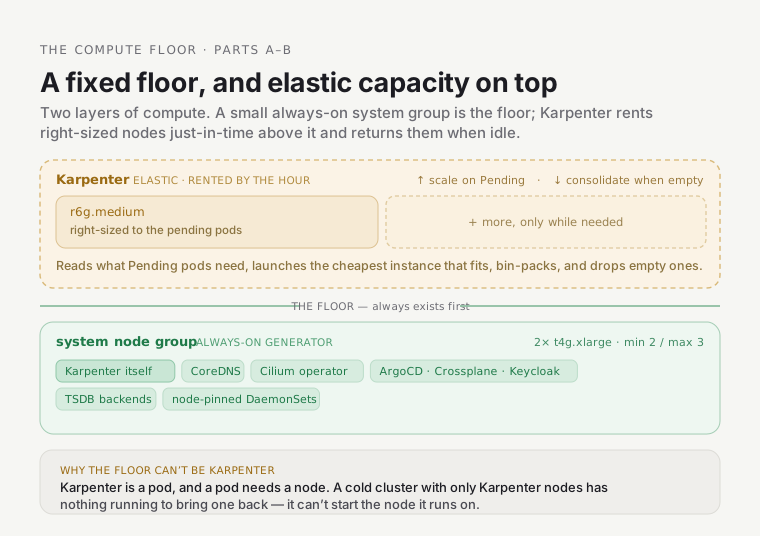
Two metaphors run throughout. The system group is an always-on generator — the lights that can never go out. Karpenter is renting generators by the hour — right-sized capacity, just-in-time, returned when quiet. Almost every design choice below is one of those two defending its job.
Part A — the compute floor: why one node group can never be Karpenter’s
Section titled “Part A — the compute floor: why one node group can never be Karpenter’s”Start with the thing that must exist before anything else can run: the system managed node group. On the platform (hub) cluster it is, verified live:
$ kubectl --context platform get nodes -L node-role,karpenter.sh/nodepool,node.kubernetes.io/instance-typeNAME STATUS ROLES AGE VERSION NODE-ROLE NODEPOOL INSTANCE-TYPEip-10-100-2-20.ec2.internal Ready <none> 98m v1.35.6 system t4g.xlargeip-10-100-2-28.ec2.internal Ready <none> 92m v1.35.6 default r6g.mediumip-10-100-2-38.ec2.internal Ready <none> 98m v1.35.6 system t4g.xlargeTwo t4g.xlarge nodes labelled node-role=system, and one r6g.medium with no role but a
karpenter.sh/nodepool=default label — that third one is a rented generator, and we’ll get to it in
Part B. The two system nodes are the always-on floor.
The system group is defined in
node-groups/terragrunt.hcl:
a single t4g.xlarge instance type (4 vCPU / 16 GiB, Graviton arm64), desired_size = 2,
max_size = 3, min_size = 2. Preprod’s floor is smaller — one t4g.large (2 vCPU / 8 GiB) — because
it carries no observability backends, Keycloak, or Backstage.
Why the floor can’t be Karpenter
Section titled “Why the floor can’t be Karpenter”The constraint is almost tautological once you see it: Karpenter can’t provision the node it runs on. Karpenter is a controller — a pod — and a pod needs a node. If the only nodes were Karpenter-provisioned, a cold cluster (or one where every node just got consolidated away) would have no Karpenter running, and therefore nothing to bring a node back. It’s the generator that starts the other generators: it can’t be one of the ones it starts.
So a small fixed group stays, and it’s deliberately the home for everything that is cluster-critical and un-provisionable-by-Karpenter:
- Karpenter itself — pinned there by
nodeSelector: { node-role: system }in the Helm values, so consolidation can never kill its own controller. - CoreDNS and the Cilium operator — the cluster’s own nervous system.
- The heavy standing JVM/stateful stack — Keycloak, ArgoCD, Crossplane, the Prometheus/Mimir/Loki/ Tempo/Pyroscope backends, Backstage.
- Node-pinned DaemonSet pods that simply cannot be served by an elastic node — a DaemonSet runs one pod per node, so it has nowhere to scale up to.
That last category is why the platform system node is a t4g.xlarge. The comment in
the unit is blunt about it: the per-node DaemonSet slab (Cilium, Beyla, Alloy, node-exporter, otel) plus
the standing load would saturate a 2-vCPU node at ~100% CPU — the alloy-profiles DaemonSet pod couldn’t
even fit. The xlarge buys per-node headroom; Karpenter handles bursts above this floor, never the floor
itself.
The ForceNew trap — a routine-looking apply that briefly severs the cluster
Section titled “The ForceNew trap — a routine-looking apply that briefly severs the cluster”Changing the system node group’s instance_types — say from t4g.large to t4g.xlarge — hides the
nastiest gotcha in this layer. It’s a ForceNew attribute in the AWS provider — OpenTofu can’t
mutate it in place, so it destroys the node group and creates a new one. The module’s
create_before_destroy sits only on the launch template, not the group (the group name is fixed), so
for ~3 minutes the cluster runs on replacement nodes coming up while the old ones drain.
It bites harder here than on a normal cluster because the in-cluster Tailscale subnet router gets evicted
during that window — and the subnet router is how you reach the private EKS API (Part D). So a one-line
instance-type edit, which reads like a trivial resize, briefly makes the private API server unreachable
from your laptop. The lesson: an instance_types change is a deliberate, monitored step,
planned like a small maintenance, not slipped into a routine apply.
Node hardening — three things baked into the launch template
Section titled “Node hardening — three things baked into the launch template”The system group ships a custom launch template built for hardening. Three details worth knowing:
- IMDSv2, hop limit 1.
http_tokens = "required"(session-token-only metadata) andhttp_put_response_hop_limit = 1. The hop limit is the sharp one: metadata requests get one network hop, so a pod (one hop from the node) can’t reach the instance metadata service and steal the node’s IAM-role credentials. Pods get their own identity via EKS Pod Identity, not the node’s. - Encrypted root EBS — or the launch is refused. The template sets
encrypted = trueon a 20 GiB gp3 root volume. This isn’t belt-and-suspenders: the org’senforce-encryptionSCP (DenyUnencryptedEbsOnLaunch) blocks the instance launch entirely if the volume is unencrypted — you’d seenot authorized to launch instances with this launch template. The encryption isn’t a hardening nicety; it’s the price of admission, enforced from above the account. maxPods: 110. AL2023 defaults kubelet’s max-pods to the instance’s ENI IP capacity (~35 on this size) — which makes sense on the default VPC-CNI, where every pod burns an ENI IP. But under Cilium’s overlay (cluster-pool) pods don’t consume ENI IPs, so that cap is artificial. A smallNodeConfigMIME fragment in the launch template lifts it to the Kubernetes default of 110, so density is bound by CPU/memory, not IP addresses.
Part B — Karpenter: renting the right generator, and returning it
Section titled “Part B — Karpenter: renting the right generator, and returning it”The elastic layer. When pods go Pending, Karpenter reads exactly what
they need — CPU, memory, architecture, zone — and launches the cheapest EC2 instance that fits,
bin-packing multiple pending pods onto one node where it can. When a node goes empty, it
consolidates — terminates it. That live r6g.medium from Part A is one such node; its NodeClaim
is Karpenter’s record of the rental:
$ kubectl --context platform get nodeclaimsNAME TYPE CAPACITY ZONE NODE READY AGEdefault-vtbn6 r6g.medium on-demand us-east-1c ip-10-100-2-28.ec2.internal True 92mKarpenter picked r6g.medium — not a type anyone hard-coded. That’s the whole point of Karpenter’s
instance-flexible provisioning.
Why Karpenter, not Cluster Autoscaler
Section titled “Why Karpenter, not Cluster Autoscaler”Cluster Autoscaler is ASG-bound: it scales pre-defined Auto Scaling Groups, so you need one group per
instance shape you want, it reacts slowly (it edits a desired count and waits for the ASG), and it
never bin-packs or consolidates — it only adds and removes whole groups. Karpenter is instance-flexible:
its NodePool expresses requirements (arch, families, capacity type, a memory floor), not a fixed shape,
and it picks the cheapest sufficient instance per request in seconds. On a cost-tight, park-when-idle
reference cluster, consolidation is the decisive feature — it’s the “return the generator when it’s
quiet” half of the metaphor, and Cluster Autoscaler simply doesn’t have it.
The NodePool, and the two consolidation personalities
Section titled “The NodePool, and the two consolidation personalities”The single NodePool (name default) is rendered from a
local Helm chart.
Its requirements: kubernetes.io/arch: arm64 (Graviton-first), a default family set of
t4g/m6g/m7g/c6g/r6g, and a per-cluster capacity-type + consolidation policy. That split is the
interesting part — the same module, two personalities:
| platform (hub) | preprod (spoke) | |
|---|---|---|
| capacity types | on-demand |
spot, on-demand |
consolidationPolicy |
WhenEmptyOrUnderutilized |
WhenEmptyOrUnderutilized |
consolidateAfter |
15m |
15m |
| CPU / memory ceiling | 16 vCPU / 64 GiB | 16 vCPU / 64 GiB |
Both clusters actively repack underutilized nodes onto fewer nodes to save money, not just reclaim
fully-empty ones — paired with karpenter.sh/do-not-disrupt + PodDisruptionBudgets on the hub’s stateful
TSDBs/Keycloak/CNPG databases, so a Karpenter node is never yanked out from under state regardless of
policy. What differs is consolidateAfter’s purpose: the hub’s 15m lets the post-unpark reschedule
storm fully settle before consolidation acts (a short window would consolidate mid-storm and undo its own
right-sizing); preprod’s 15m exists because a shorter one (1m, the module default, tried and reverted)
raced the BYOCNI node.cilium.io/agent-not-ready startup taint — a fresh node can sit taint-blocked
longer than 1 minute waiting on Cilium, and the disruption controller would delete it as “empty” before
its intended pod ever landed, forcing an endless provision-disrupt-repend loop. A hard limits ceiling
on both clusters means Karpenter can never runaway-provision past the cost guardrail.
Three details that keep Karpenter honest
Section titled “Three details that keep Karpenter honest”Auth is Pod Identity, not IRSA. The controller’s IAM role trusts pods.eks.amazonaws.com,
and the karpenter ServiceAccount carries no IRSA annotation — the Helm values explicitly set
annotations: {}. Platform add-ons use Pod Identity rather than IRSA.
The Cilium-first startup taint. Every Karpenter node is born with a taint, verified live on the NodePool:
$ kubectl --context platform get nodepool default -o jsonpath='{.spec.template.spec.startupTaints}'[{"effect":"NoSchedule","key":"node.cilium.io/agent-not-ready"}]This is the “wet paint” sign, expressed for nodes that appear at 3 a.m. Because the cluster is BYOCNI (Cilium installed before nodes are Ready), a fresh node has no networking until Cilium’s agent DaemonSet lands on it. The taint repels application pods until Cilium comes up and removes the taint itself — extending the Cilium-first rule the static groups already satisfy to every node Karpenter ever creates. Skip this and pods schedule onto a node with no CNI and hang.
The ≥ 8 GiB floor. The NodePool sets min_instance_memory_mib = 6144, which excludes anything
smaller than 8 GiB (that live r6g.medium is exactly 8 GiB). The reason: the per-node DaemonSet slab —
Cilium, Beyla, Alloy, node-exporter, otel — eats a fixed ~3.2 GiB on every node regardless of workload.
On a 4 GiB t4g.medium that slab exhausts memory, the kubelet flaps NotReady, and the node churns. The
floor guarantees enough headroom that the slab is a tax, not a death sentence.
The mandatory SCP exemption — the 403 that blocks every launch
Section titled “The mandatory SCP exemption — the 403 that blocks every launch”This is the operational trap that will stump you on a rebuild if you don’t know it. Karpenter tags the
instances it creates with governance tags — but it applies them via the launch template, not on the
ec2:RunInstances request. Two org SCPs sit above the account and reject that:
require-taggingdeniesec2:RunInstanceswhenEnvironment/ManagedBy/Ownerare absent from the request.DenyTeamTagTamperingdenies theTeamtag onec2:CreateTags.
So a non-exempt Karpenter controller gets a 403 on every single node launch. The fix lives in
mgmt/global/organizations,
and note how it’s written — anchored per cluster, not a leading wildcard:
exempt_roles = [ # ... "platform-use1-eks-karpenter-*", "preprod-use1-eks-karpenter-*",]That anchoring is a deliberate security choice from the audit: platform-use1-eks-karpenter-* matches the
module’s name_prefix, so an unrelated role that merely contains -karpenter- can’t inherit the
exemption via a sloppy *-karpenter-*. And this SCP change must be applied before Karpenter
first provisions, or the cluster can’t build — a real rebuild-ordering dependency, not an afterthought.
Part C — the descheduler: the maître d’ who rebalances the room
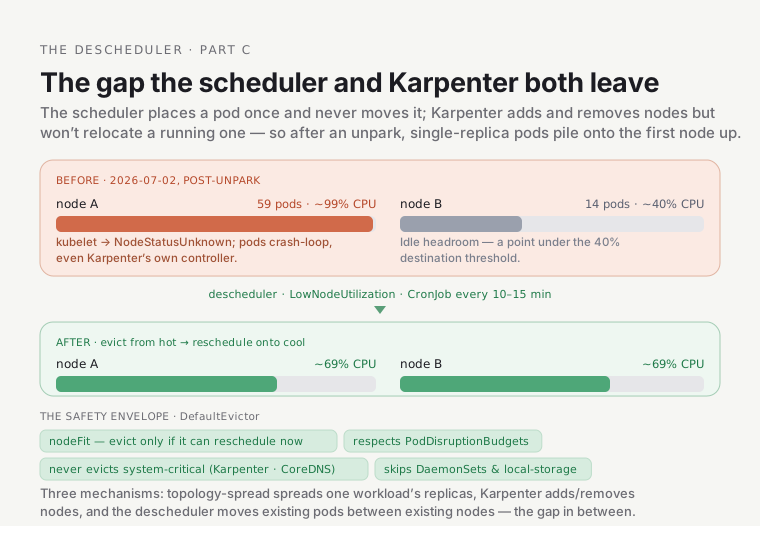
Section titled “Part C — the descheduler: the maître d’ who rebalances the room”Karpenter adds and removes nodes. It does not move a pod that’s already placed — and neither does the Kubernetes scheduler, which places a pod exactly once and never revisits the decision. That gap is a real, bounded failure mode, and it has a name and a date.
The descheduler is built and live on both clusters. Live proof:
$ kubectl --context platform get cronjob -n kube-system deschedulerNAME          SCHEDULE       SUSPEND   ACTIVE   LAST SCHEDULE   AGEdescheduler   */15 * * * *   False     0        7m2s            4d21h
$ kubectl --context preprod get cronjob -n kube-system deschedulerNAME          SCHEDULE       SUSPEND   ACTIVE   LAST SCHEDULE   AGEdescheduler   */10 * * * *   False     0        2m3s            4d21h
The incident behind it
Section titled “The incident behind it”On 2026-07-02, post-unpark, one preprod t4g.large absorbed 59 pods — ~99% of CPU requests, 189% of
memory limits — while the other node sat at 14 pods (~40%). This wasn’t a capacity problem: balanced
across the two nodes the same workload fits at ~69% each. It was a pure distribution problem, and the
consequences cascaded. The overloaded node’s kubelet degraded to NodeStatusUnknown; every pod on it
crash-looped — including Karpenter’s own controller. The one component that could have added relief
capacity was itself starved on the very node it would have relieved. Autoscaling deadlocked.
Why does everything pile onto one node? After a staggered unpark, the “emptiest node” — the one
the scheduler prefers — is the first node up, and a dozen independent single-replica controllers
(argo-rollouts, external-dns, kube-state-metrics, …) each independently pick it. topologySpreadConstraints
don’t help: they spread the replicas of one workload, not independent workloads. And manual
kubectl delete doesn’t reliably fix it either — the scheduler frequently re-pins the pod to the same hot
node.
The rebalancer, and its safety envelope
Section titled “The rebalancer, and its safety envelope”The fix is the kubernetes-sigs descheduler running the
LowNodeUtilization strategy as a CronJob — a periodic sweep, the right shape for correcting
churn (unpark, consolidation, node replacement) rather than a hot loop. It evicts pods off nodes above the
overutilized thresholds so they reschedule onto nodes below the underutilized thresholds. This is the
maître d’ — walking a lopsided dining room and moving parties to emptier tables.
The thresholds are per-cluster, and the reason is subtle:
| underutilized (destination) | overutilized (source) | cadence | |
|---|---|---|---|
| platform | 40% | 70% | every 15 min |
| preprod | 50% | 70% | every 10 min |
LowNodeUtilization only rebalances if some node qualifies as a destination — below all the
underutilized thresholds. In the 2026-07-02 incident the cool node sat at 39% CPU — one point under the
40% default, which would have just barely qualified. Preprod raises the destination threshold to 50%
to give the emptier of two small nodes reliable headroom to be a valid target, and tightens cadence to 10
minutes because that’s the cluster where a hot node actually melts down. Platform keeps the calm 40/70
defaults: bigger nodes, do-not-disrupt-protected stateful services, and fewer evictions being better.
The maître d’ analogy carries a critical caveat: only to a seat that fits, and never mid-meal. The
descheduler
module enforces
exactly that through the DefaultEvictor:
nodeFit: true— a pod is evicted only if it could actually be scheduled onto another node right now. This is the guard against the failure mode a naivekubectl deletehits: rebalancing never strands a podPending.- Respects PodDisruptionBudgets — the workload PDBs and the CNPG database PDBs are never violated.
evictSystemCriticalPods: false— pods atsystem-cluster-criticaland above (Karpenter, CoreDNS) are left in place. The descheduler doesn’t move them — it protects them indirectly, by relieving the hot node around them.- Skips DaemonSet, static/mirror, and controller-less pods, and never evicts pods with local storage
(
evictLocalStoragePods: false) — no data loss.
The elegant bit: the descheduler never touches Karpenter, yet it’s what keeps Karpenter alive. By rebalancing ordinary workloads off a hot node, it stops that node from degrading to the point where it crash-loops the critical controllers sharing it. Three mechanisms, cleanly separated: topology-spread spreads one workload’s replicas, Karpenter adds and removes nodes, and the descheduler moves existing pods between existing nodes — the gap neither of the others covers.
Part D — the staff door: reaching a cluster with no public endpoint
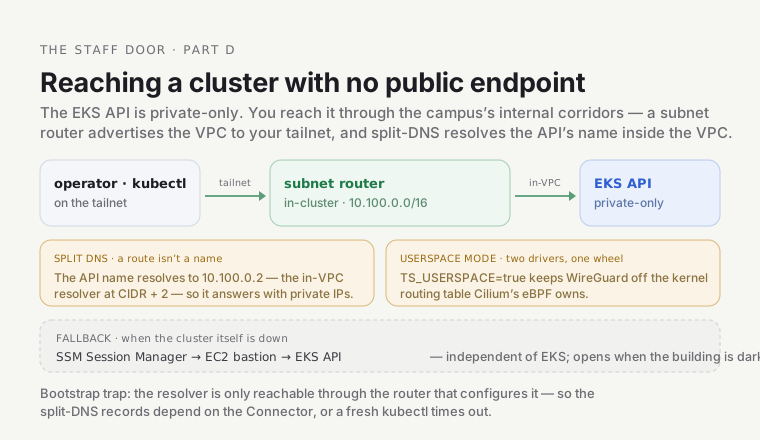
Section titled “Part D — the staff door: reaching a cluster with no public endpoint”The EKS API is private-only — no public endpoint at all. So how do you run kubectl? Not
through a hole in the wall; through the campus’s internal corridors. The primary path is
Tailscale, verified live as a Connector:
$ kubectl --context platform get connectorNAME SUBNETROUTES ISEXITNODE ISAPPCONNECTOR STATUS AGEplatform-use1-eks-subnet-router 10.100.0.0/16 false false ConnectorCreated 23dHow the subnet router works
Section titled “How the subnet router works”A Tailscale subnet router runs as a pod inside the cluster and advertises the whole VPC CIDR
(10.100.0.0/16 on platform, 10.101.0.0/16 on preprod) to your private tailnet. Join the tailnet
and every IP in that range becomes routable from your laptop — including the private EKS API endpoint and
any other in-VPC resource (Grafana, databases). The Connector and
ProxyClass are CRDs, so
the config is in git; OAuth client credentials come from AWS Secrets Manager (platform/tailscale/oauth),
read via an OpenTofu Secrets Manager data source at apply time.
But an IP route isn’t enough — you also need the API server’s name to resolve. The API’s DNS name only
answers with private IPs inside the VPC, via the VPC’s own resolver. So the module publishes split
DNS: queries for us-east-1.eks.amazonaws.com and aws.refplat.org are routed to 10.100.0.2 — the
in-VPC Amazon-provided resolver, which always sits at VPC CIDR + 2. Now aws eks update-kubeconfig
followed by a plain kubectl just works, no tunnel, no public endpoint.
The userspace-mode detail — two drivers, one steering wheel
Section titled “The userspace-mode detail — two drivers, one steering wheel”The most consequential line in the Tailscale config is the two-drivers-grabbing-one-wheel problem. The
subnet router runs in userspace mode — TS_USERSPACE=true, set via the ProxyClass:
spec: statefulSet: pod: tailscaleContainer: env: - name: TS_USERSPACE value: "true"Default (kernel-mode) Tailscale creates its own tun interface and writes routes directly into the Linux
kernel routing table. But Cilium’s eBPF dataplane owns that table. Two components both trying to
program kernel routing is the two-drivers problem: packet loss, routing loops. Userspace mode runs the
entire WireGuard tunnel inside the Tailscale process, off the kernel path — Tailscale gets its own wheel.
The cost is slightly higher CPU per byte, which is negligible for developer kubectl traffic. Where it
shares with the metaphor: both drivers are competent; the problem is purely that there’s one wheel.
Where it breaks: unlike two literal drivers, kernel-mode Tailscale doesn’t just fight for control — it
silently corrupts routing, so the symptom is dropped packets, not a visible struggle.
The split-DNS bootstrap trap — locked in with the key inside
Section titled “The split-DNS bootstrap trap — locked in with the key inside”This trap has a name: “kubectl times out even though I’m on Tailscale.” Split DNS points
the API hostname at 10.100.0.2 — a resolver only reachable through the subnet router. During a
bootstrap (or if the router pod is down), the name resolves before the route that makes the resolver
reachable exists. You’ve locked yourself in the room with the key on the inside: the thing that answers
“where is the API?” is itself only reachable once the API path is up. This is exactly why the module
creates the split-DNS records with a depends_on the Connector — DNS entries only appear after the subnet
router is online.
The SSM fallback — a door independent of the cluster
Section titled “The SSM fallback — a door independent of the cluster”Tailscale’s weakness is circular: the operator pod runs on the cluster, so if the cluster is completely
down, so is Tailscale. The fallback is
scripts/eks-tunnel.sh — an
SSM Session Manager port-forward through an EC2 bastion that is entirely independent of EKS. It
discovers the bastion by Name tag, forwards localhost:8443 → <eks-endpoint>:443, and rewrites your
kubeconfig to point there. It even self-heals: SSM sessions die after ~20 min idle, so the script loops and
reconnects within ~2 seconds. It’s the door that still opens when the building’s own systems are dark.
Operate, not author
Section titled “Operate, not author”One security note ties Parts A–C together. Whether you arrive via Tailscale or SSM, the role
kubectl assumes is PlatformAdmin, scoped to operate, not author. Concretely:
the EKS access entry grants the AWS-managed AmazonEKSViewPolicy (broad read) plus a platform-operator
ClusterRole scoped to operate, not author. It grants create on the debug verbs — pods/exec,
pods/portforward, pods/eviction (drain), and throwaway debug pods (pods + pods/ephemeralcontainers,
for kubectl run/debug) — plus delete/patch on pods, patch on nodes (cordon) and on apps
workloads (rollout restart), patch/update/delete on a bounded named allow-list of operational
custom resources (Karpenter NodeClaims, Crossplane managed resources/XEnvironments, CNPG Clusters), and
cluster-wide get/list/watch on everything for debugging. The real boundary isn’t “no create” — it’s
no create on apps/Deployments and no arbitrary-CRD authoring. You can debug, drain, and restart to
your heart’s content; you cannot hand-create a Deployment or edit a system namespace. Authoring goes through
GitOps — even the humans who run the platform hold no standing power to rewrite it by hand. (The one real residual: pods/exec lets a
shell read that pod’s mounted secrets and reach its Pod-Identity credentials — a deliberate trade for
debuggability.)
Gotchas that teach
Section titled “Gotchas that teach”- The floor can’t be Karpenter, ever. Karpenter can’t provision its own node — so a fixed system group
must always exist, and it must be big enough to hold the DaemonSet slab plus the standing stack plus
any node-pinned DaemonSet pod. That’s why platform’s floor is
t4g.xlarge, notlarge. instance_typesis ForceNew — and it evicts the subnet router. A one-line node-type resize destroys and recreates the managed group (~3-min blip) and takes the in-cluster Tailscale router with it, briefly cutting private API access. Plan it as maintenance.- Encryption isn’t optional — the SCP refuses the launch. An unencrypted root volume doesn’t get a
warning;
DenyUnencryptedEbsOnLaunchblocks the instance from starting at all. - Karpenter’s 403 is above the account. No node launches +
UnauthorizedOperationonRunInstancesmeans the SCP exemption is missing or misspelled — it lives inmgmt/global/organizations, anchored per cluster, and must be applied before first provision. - The 8 GiB floor is a kubelet-stability floor, not a preference. The ~3.2 GiB DaemonSet slab exhausts
a 4 GiB node and flaps it
NotReady;min_instance_memory_mib = 6144keeps it stable. nodeFit: trueis the difference between rebalancing and an outage. Without it, eviction can strand a podPending— which is exactly why naivekubectl deleteisn’t a fix.- Userspace Tailscale isn’t a preference — it’s coexistence with Cilium. Kernel mode silently corrupts routing by fighting eBPF for the kernel table.
- Split DNS is a bootstrap chicken-and-egg. The resolver that answers “where is the API?” is only
reachable through the API path — so a
kubectltimeout on a fresh cluster is usually the router being down, not your auth.
Go deeper — source of truth
Section titled “Go deeper — source of truth”- Modules:
aws/eks-node-group,aws/karpenter(+ the NodePool chart),descheduler,tailscale. - The cluster-parking and cluster-access house skills for the operational procedures.
- Back to the Foundations orientation.