Deep dive: how the Composition renders
The orientation showed one claim becoming about seventeen resources and called the Composition “the recipe.” That’s the right mental model. To change or debug the Composition you need the mechanism underneath it: how it renders seventeen specific resources from a compact claim, and how those become real things in AWS and the cluster. It comes down to one idea, a three-step pipeline, and a lot of go-template.
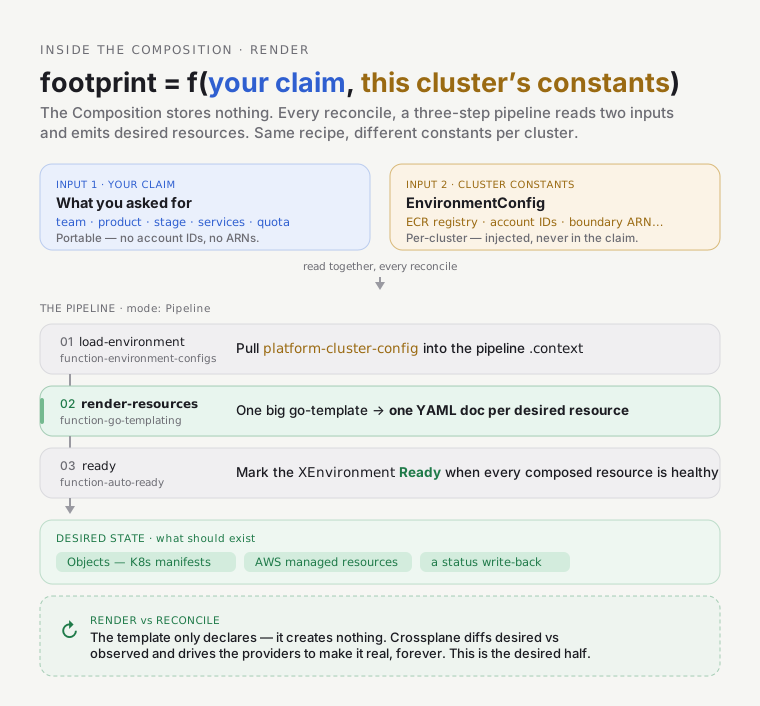
The one idea: rendered footprint = f(your claim, this cluster’s constants)
Section titled “The one idea: rendered footprint = f(your claim, this cluster’s constants)”The Composition is a pure function of two inputs:
- Your claim — what you asked for (
team,product,stage,services,quota, …). - This cluster’s constants — the ECR registry, the account IDs, the permissions-boundary ARN, the base domain, the cross-account pull accounts. These differ per cluster and must not live in a portable claim.
It reads both and emits a set of desired resources. Same recipe, different ingredients per cluster: your claim plus this cluster’s constants gives preprod-flavoured resources on preprod, prod-flavoured on prod. Everything below is how it reads the ingredients and what it emits.
The pipeline: three functions
Section titled “The pipeline: three functions”The Composition runs in mode: Pipeline — an ordered list of
functions, each handed the previous
one’s output plus a shared context:
load-environment→function-environment-configs. Finds theEnvironmentConfignamedplatform-cluster-configand drops it into the pipelinecontextunder a well-known key, so later steps can read the cluster constants without hard-coding them.render-resources→function-go-templating. Runs one large inline go-template. Its output is a multi-document YAML stream — one YAML doc per desired resource. Almost all the logic lives here.ready→function-auto-ready. Watches the composed resources and marks theXEnvironmentReadyonce they report ready. No logic of its own — it just closes the loop.
The middle step is the machine; the other two feed it and finish it.
Input 1 — your claim (and the desired/observed model)
Section titled “Input 1 — your claim (and the desired/observed model)”Crossplane hands the go-template the observed state — the live objects as they currently are — and the template returns desired state — what should exist. It reads the claim off the observed composite:
{{- $spec := .observed.composite.resource.spec }}{{- $xrName := .observed.composite.resource.metadata.name }}{{- $team := $spec.team }}{{- $product := $spec.product }}{{- $stage := $spec.stage }}That observed/desired split is why this is safe to re-run. The template is a pure function of the observed claim, run every reconcile. It never mutates; it re-declares what should exist, and Crossplane diffs desired-vs-observed and closes the gap. This is a thermostat seen from the inside: the template writes the set-point (desired), Crossplane reads the thermometer (observed) and drives toward it, forever. This deep dive is the desired half.
Almost everything is derived, not stored. The namespace name is computed as <team>-<product>-<stage>, with a
deterministic truncate-and-hash if it would blow the 63-char DNS limit:
{{- $ns := printf "%s-%s-%s" $team $product $stage }}{{- if gt (len $ns) 63 }}{{- $ns = printf "%s-%s" (substr 0 56 $ns) (substr 0 6 (sha256sum $ns)) }}{{- end }}Input 2 — the cluster’s constants (an EnvironmentConfig)
Section titled “Input 2 — the cluster’s constants (an EnvironmentConfig)”The values that can’t live in a portable claim come from an EnvironmentConfig named platform-cluster-config.
Step one loaded it into context; the template reads it back:
{{- $cfg := index .context "apiextensions.crossplane.io/environment" }}{{- $ecrCfg := $cfg.providerConfigEcr | default "default" }}{{- $pullAccts := $cfg.pullAccountIds | fromJson }} {{/* stored as a JSON-array string */}}{{- $ecrPrincipals := list }}{{- range $a := $pullAccts }}{{- $ecrPrincipals = append $ecrPrincipals (printf "arn:aws:iam::%s:root" $a) }}{{- end }}That EnvironmentConfig is Helm-templated per cluster from the module’s inputs:
data: ecrRegistry: "<platform-acct>.dkr.ecr.us-east-1.amazonaws.com" workloadAccountId: "…" permissionsBoundaryArn: "arn:aws:iam::…:policy/environment-permissions-boundary-…" providerConfigEcr: "platform-ecr" # which credentials the ECR resources use pullAccountIds: "[\"620…\",\"554…\"]" # JSON-array string → the cross-account pull principals aboveThe claim stays clean because the constants are injected here. Notice $ecrPrincipals is already being built
from pullAccountIds — that matters for the cross-account ECR repo below.
Worked resource A — the namespace (a Kubernetes Object)
Section titled “Worked resource A — the namespace (a Kubernetes Object)”Kubernetes-side resources are emitted as an Object — a provider-kubernetes
managed resource (MR) that wraps a plain Kubernetes
manifest. Each carries a composition-resource-name annotation so Crossplane can track it across reconciles:
kind: Objectmetadata: annotations: gotemplating.fn.crossplane.io/composition-resource-name: namespacespec: providerConfigRef: { name: default } # in-cluster forProvider: manifest: apiVersion: v1 kind: Namespace metadata: name: {{ $ns }} labels: platform.refplat.org/team: {{ $team }} platform.refplat.org/product: {{ $product }} platform.refplat.org/stage: {{ $stage }}Render it offline and that’s exactly what falls out — a real crossplane render of the demo-dev fixture
(from the module’s .environment-api-tests/):
crossplane render environments/demo-dev.yaml ../charts/environment-api/files/composition.yaml \ render/functions.yaml --extra-resources render/environmentconfig.yamlkind: Object# ...spec: forProvider: manifest: apiVersion: v1 kind: Namespace metadata: labels: app.kubernetes.io/managed-by: crossplane platform.refplat.org/product: demo platform.refplat.org/stage: dev platform.refplat.org/team: alpha platform.refplat.org/tier: standardInput → template → output.
Worked resource B — the ECR repository (an AWS MR, and the cross-account hop)
Section titled “Worked resource B — the ECR repository (an AWS MR, and the cross-account hop)”The AWS side is where the orientation’s “one cross-account hop” becomes concrete. Inside the service loop, the
template emits an ecr.aws.upbound.io Repository — a real AWS resource this time, not a wrapped manifest:
{{- range $svc, $svccfg := $spec.services }}{{- $repo := printf "team-%s/%s-%s" $team $product $svc }}kind: Repositorymetadata: annotations: gotemplating.fn.crossplane.io/composition-resource-name: ecr-repo-{{ $svc }} crossplane.io/external-name: {{ $repo }}spec: deletionPolicy: Orphan # product-scoped + shared across stages — never delete on teardown providerConfigRef: { name: {{ $ecrCfg }} } # ← "platform-ecr": assume-role into the PLATFORM account forProvider: region: {{ $cfg.region }} imageTagMutability: IMMUTABLE_WITH_EXCLUSION ...{{- end }}Two things make this the cross-account hop:
providerConfigRef: platform-ecr— every non-ECR resource usesdefault(Pod Identity in the workload account); the three ECR resources (Repository,RepositoryPolicy,LifecyclePolicy) useplatform-ecr, a ProviderConfig that assume-role-chains into the platform account. So the repo is created there, centrally.- The
RepositoryPolicygrants pull to$ecrPrincipals— thearn:aws:iam::<acct>:rootlist built from the EnvironmentConfig’spullAccountIds— so the workload accounts can pull the image back.
Render the fixture and the ecr-repo-web resource shows the tell-tale pair — a product-scoped external name,
and the platform-ecr ProviderConfig (the three ECR resources use platform-ecr; every non-ECR resource in
that render uses default):
# the ECR Repository, straight out of `crossplane render` of demo-dev:metadata: annotations: crossplane.io/composition-resource-name: ecr-repo-web crossplane.io/external-name: team-alpha/demo-webspec: providerConfigRef: name: platform-ecrOne template, reading one set of cluster constants, produces a resource in a different AWS account with a policy back to the workload accounts. That’s the whole cross-account story, in about 15 lines of go-template.
Where “seventeen” comes from — a fixed set plus the service loop
Section titled “Where “seventeen” comes from — a fixed set plus the service loop”Some resources render once per environment: the namespace, quota, limit-range, network policies, rolebinding,
and the two Kyverno policies. The rest render per service, inside the range $svc, $svccfg := $spec.services
loop — for each service, an ECR Repository, its RepositoryPolicy and LifecyclePolicy, an IAM Role, a
PodIdentityAssociation, and (if declared) self-service S3/SQS/… resources. So:
footprint size = the fixed set + (per-service resources × number of services)
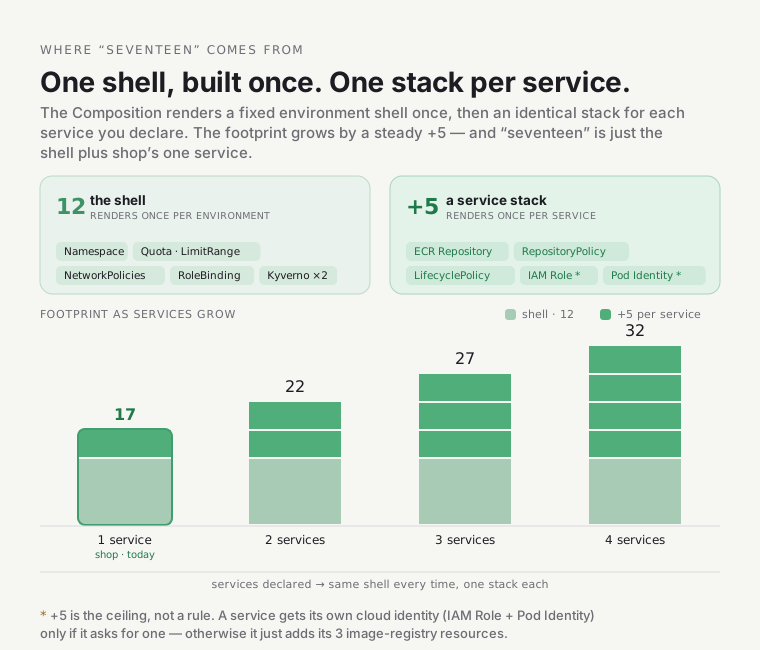
shop has one service (web), which is exactly why its footprint is the size it is; a two-service product
renders a second stack of ECR + IAM + Pod-Identity resources.
You can prove the formula. Render demo-dev, add a second service to the claim
(services: { web: { … }, api: {} }), and re-render. The fixed set is unchanged, and a per-service stack
appears for api — but only its ECR trio (Repository + RepositoryPolicy + LifecyclePolicy), because
api: {} declares no serviceAccount. The IAM Role and PodIdentityAssociation render only when a service
declares a serviceAccount (e.g. api: { serviceAccount: demo-api }). The gate is the serviceAccount, not
the image.
The status write-back — one derivation, two outputs
Section titled “The status write-back — one derivation, two outputs”The Composition doesn’t only create child resources — it also writes the composite’s own status. Near the end,
the template builds the environment’s host list (the generated <product>-<team>-<stage>.<baseDomain> plus any
bound spec.domains) and emits a bare XEnvironment carrying just status.domains:
{{- $gen := printf "%s-%s-%s.%s" $product $team $stage $base }}kind: XEnvironmentmetadata: { name: {{ $xrName }} }status: domains: - host: {{ $gen }} state: Active reason: GeneratedHost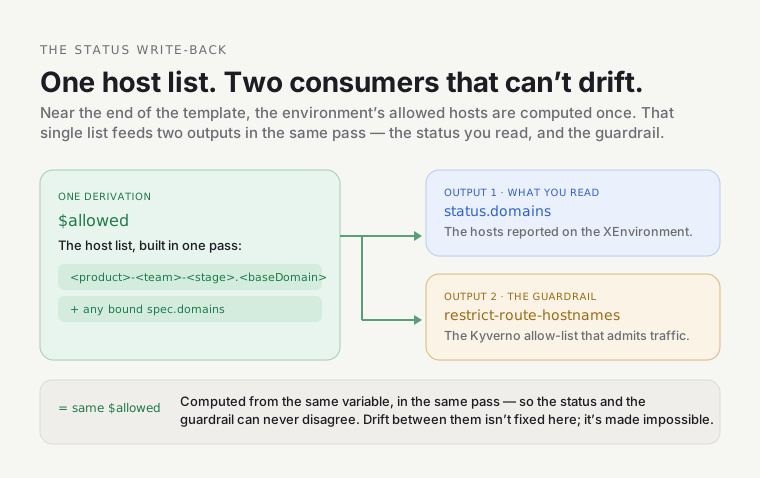
That same host list feeds two outputs — the status.domains above and the Kyverno restrict-route-hostnames
policy’s allow-list (rendered right after, from the same $allowed variable). One derivation, two consumers:
the status you read and the guardrail that enforces it can’t drift apart, because they’re computed from the
same list in the same pass.
From render to reconcile — how “desired” becomes real
Section titled “From render to reconcile — how “desired” becomes real”The template’s whole output is desired state — a pile of Objects and AWS MRs. It doesn’t create anything itself. What happens next is the reconciliation from the orientation:
- Crossplane takes the desired resources and diffs them against observed (what already exists).
- For anything missing or drifted, the relevant provider (provider-kubernetes, provider-aws) makes the real thing — the actual namespace, the actual ECR repo in the platform account, the actual IAM role.
function-auto-readymarks theXEnvironmentReadyonce they’re all healthy.- And it never stops — every reconcile re-runs this exact template and re-closes the gap. That’s why deleting the ECR repo by hand just brings it back: the next render still desires it.
So “render” (compose the desired set) and “reconcile” (drive reality to it) are the two halves. This deep dive is the first half; the orientation’s self-heal is the second.
The go-template toolbox
Section titled “The go-template toolbox”The template isn’t string substitution — it’s Go templates plus
Sprig functions, so you have a real little language: printf, index,
range, default, dict/list, append, set, uniq, sortAlpha, fromJson/toJson, sha256sum,
substr. That’s how it derives names, parses the JSON-string constants, builds principal lists, and de-dupes
hosts — all at render time, before anything touches a cluster.
A few things that will bite you
Section titled “A few things that will bite you”- The Composition ships raw; the EnvironmentConfig does not. The Composition file is emitted verbatim by its
Helm wrapper —
{{ .Files.Get "files/composition.yaml" }}— so Helm leaves its{{ }}untouched. Those braces are a go-template run byfunction-go-templatingon the cluster, not Helm. TheEnvironmentConfignext to it is an ordinary Helm template (its{{ .Values… }}are filled at install time). Same braces, opposite processors — edit accordingly. composition-resource-nameis a resource’s identity across reconciles. Think of it as the resource’s name tag: each reconcile, Crossplane matches this render’s resources to the last render’s by the tag. Rename the tag and it sees a stranger — it seats the new resource and evicts the old. A quiet way to churn a live environment (and the ECR repo’sdeletionPolicy: Orphanis precisely the guard against that costing you images).- A
suspended/decommissioninglifecycle zeroes the ResourceQuota in the template — a reversible grace state — while retaining everything else.
Working on it safely
Section titled “Working on it safely”- Render before you apply — always.
crossplane renderruns the real pipeline functions offline, no cluster; the harness’srender.shrenders the fixtures and asserts the footprint. You see exactly what your change produces before it touches a live environment. Change a line, re-render, diff. - Treat XRD / Composition edits as high-risk. A breaking change can cascade to live
XEnvironments. The render harness is your safety net; never blind-apply.
Go deeper
Section titled “Go deeper”- The
crossplane-composition-authoringhouse skill — the authoring how-to (producer side). - Crossplane Environment API — the as-built reference.
- Back to the orientation · the reference.