How the Platform Fits Together
The Life of a Deployment followed one event through the machinery — the journey. This is the map: the standing structure that journey moved through. Read that one first; it gives these pieces motion, and this gives them a shape and a place.
The question
Section titled “The question”One deployment threads across ten planes. A map asks the structural questions the journey doesn’t: what are all these control planes? How are they arranged — what sits on top of what? Where do they physically run, and who owns which parts?
Answer those and the platform stops being a bag of tools with cool names and becomes a structure you can hold in your head — the kind you can navigate at 3 a.m. during an incident, when the question isn’t “how does this work in theory” but “the shop is down, which box do I even look in.” A good map turns panic into a lookup.
Control planes all the way down
Section titled “Control planes all the way down”One idea makes the whole platform legible: the thermostat — watch desired vs. actual, close the gap — which the Environment API and Life of a Deployment each explore in depth. Generalize it as hard as it will go:
Every layer of this platform is the same shape: you declare desired state in git, and a control plane reconciles reality to match it. AWS accounts. The network. The cluster itself. Provisioned environments. Deployed workloads. Policy. Identity. Running agents. All of it. The same declare-then-reconcile loop, repeated at every altitude — from “which AWS accounts exist” at the bottom to “which AI agents are running” at the top.
Watch the same loop appear at three different altitudes:
| At this altitude… | you declare… | and this control plane reconciles reality to it |
|---|---|---|
| Cloud foundations | AWS resources, in .hcl |
Terragrunt / OpenTofu |
| Provisioning | an XEnvironment claim |
Crossplane |
| Delivery | a Release digest | ArgoCD |
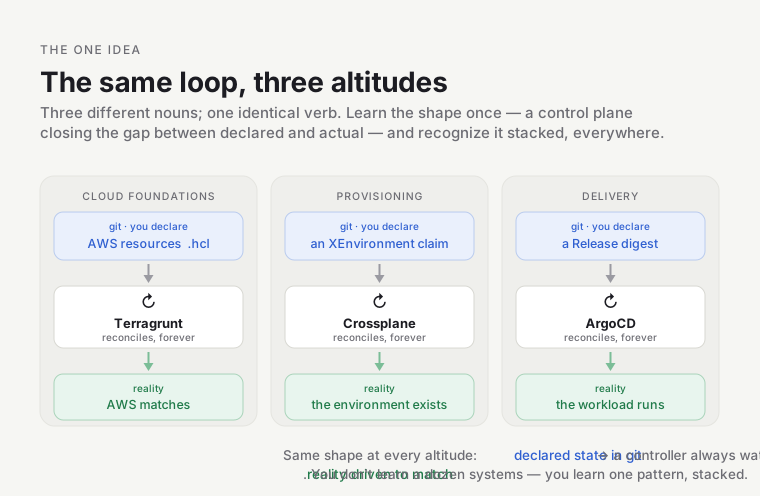
Three different nouns, one identical verb: declared state in git, a controller always watching, reality driven to match. That self-similarity is the gift. You don’t learn a dozen unrelated systems; you learn one pattern — a control plane closing the gap between declared and actual — and then recognize it, stacked, over and over. The planes differ in what they reconcile and are identical in how. Once the shape clicks for one, it has clicked for all of them.
Another way to hold it: the platform is an operating system for shipping software. The mapping is surprisingly exact:
| In an operating system… | …on this platform |
|---|---|
| Hardware | AWS accounts + network |
| The kernel (schedules, isolates) | the EKS cluster |
| Device drivers | the providers (Crossplane’s AWS/K8s providers, the CNI) |
| System daemons | the control planes (ArgoCD, Kyverno, Karpenter, …) |
| System calls — how you request work | git |
| Processes / user space | your Product’s running workloads |
| The shell / desktop | Backstage |
| syslog / dmesg | the observability stack |
| Users & file permissions | identity & access (Keycloak, Pod Identity) |
The metaphor breaks at the important place. A real OS has a kernel scheduler — one central authority dispatching work. This platform has no such center. Its “daemons” are autonomous, independent control loops (the ones Life of a Deployment follows); they coordinate only through git, never through a conductor. So: an OS for its layering, choreography for its control. Hold both, and you can reason about almost anything on the platform by asking “which layer, and which loop?”
The altitudes — what sits on what
Section titled “The altitudes — what sits on what”Read this bottom to top. The organizing principle is the one that makes an OS tractable: each layer takes the one below as a given, hides that complexity, and offers a simpler abstraction to the layer above. You use the cluster without thinking about EC2; you deploy a workload without thinking about the cluster. Each rung raises the floor.
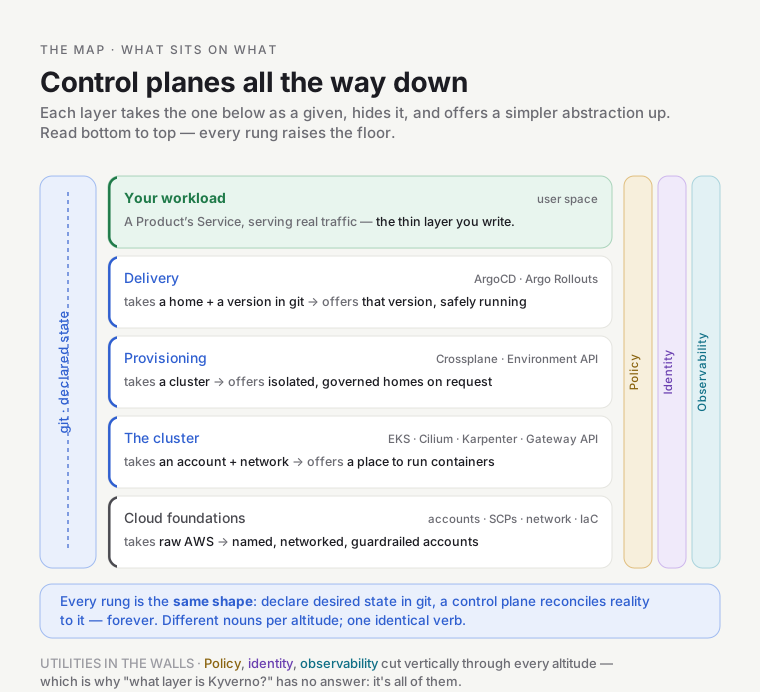
Cloud foundations — the ground. At the bottom: multiple AWS accounts under an organization, fenced by guardrail SCPs (service control policies that make whole categories of action impossible, org-wide); the network (VPCs, a Transit Gateway stitching accounts together, private DNS); and the IaC that builds it all (OpenTofu + Terragrunt). It takes raw AWS and offers named, networked, guardrailed accounts. Its control plane is Terragrunt, reconciling AWS to the .hcl you commit. This is the hardware layer — everything else runs on it and mostly ignores it.
The cluster — the kernel. On an account’s network sits an EKS cluster, and three planes make it usable. Cilium gives every pod an address and enforces who may talk to whom (the network stack). Karpenter watches for pods that can’t be scheduled and conjures a right-sized node in seconds, then removes it when idle (the memory manager, sort of — capacity on demand). The Gateway API is the doorway for outside traffic. It takes an AWS account with a network and offers a place that runs containers and connects them. This is the kernel — it schedules work onto hardware and isolates tenants from each other.
Provisioning — the environment factory. Crossplane runs the Environment API. A nine-line XEnvironment claim becomes a namespace, an image registry, scoped AWS permissions, resource quotas, and admission guardrails — a whole furnished, isolated home. It takes a cluster and offers isolated, governed homes for Products, on request. This is the layer that hands out address space and permissions — the part of the kernel that gives each program its own protected memory, raised to the level of a whole environment.
Delivery — git to running. ArgoCD plus Argo Rollouts take the manifests and the promoted image digest sitting in git and turn them into a running, health-gated, automatically-canaried workload inside one of those homes. It takes a home plus a desired version in git and offers that version, safely running. This is the loader and the process scheduler — it takes a program off disk and gets it executing, carefully.
Your workload — user space. Your Product’s Service, finally running and serving customers. Everything below exists so that this layer can be small: you write the app, not the platform. That is the entire point of the stack — to make the interesting layer the thin one.
The bands that cut across every layer
Section titled “The bands that cut across every layer”The stack above is the delivery path — how code becomes a running service. But three planes refuse to sit on any single rung. They cut vertically through all of them — the three vertical bands in the altitudes diagram above — which is why they feel omnipresent and why newcomers can’t figure out “what layer is Kyverno?” The answer is all of them.
- Policy — Kyverno (and its cousins). Guardrails apply at every altitude: SCPs guard the accounts, admission policies guard the workloads, image policies guard the registry, network policies guard traffic. Policy is not a layer; it is a rule every layer must answer to. It cuts down through the whole stack, saying “no” at each floor.
- Identity & access — Keycloak + Pod Identity. Who (humans, via Keycloak SSO) and what (workloads, via Pod Identity) may act — asked and answered at every layer, from “who may assume this AWS role” at the bottom to “who may merge this Release” in the middle to “what may this pod reach” at the top. One question — are you allowed? — posed on every floor.
- Observability — the LGTM+P stack. The nervous system. Every layer emits signals into it, and — as Life of a Deployment traces — the delivery layer even reads back from it to gate canaries. Observability watches the entire stack at once and, at the top, wires some of what it sees to action (alerts, on-call, the triage copilot).
If the delivery stack is a building, these three are the utilities — plumbing, power, security — that run through every floor rather than occupying one. You never visit “the electricity floor”; it’s in the walls, everywhere. That’s why they’re modeled as their own sub-curricula in the inventory: each is big because it touches everything.
Where it all runs — hub and spokes
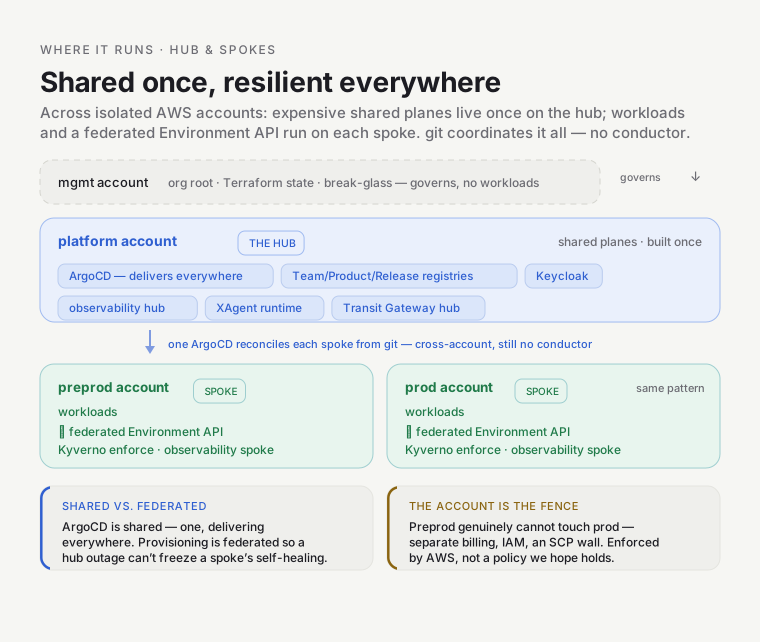
Section titled “Where it all runs — hub and spokes”That’s the logical stack. Physically, it lives in a hub-and-spoke topology across a handful of AWS accounts — a deliberate answer to three pressures at once: don’t duplicate shared services, contain blast radius, and use the AWS account as the hard isolation boundary.
Picture an airline hub. The expensive shared machinery — the big maintenance hangar, the operations center, the reservations system — lives once, at the hub. Flights (deliveries) radiate out to the spoke airports, which run their own local operations but rely on the hub’s shared systems. You don’t build a reservations system at every airport; you build it once and connect. Where it breaks: airline spokes are fairly independent, but here the hub also holds the governance (identity, policy source, the registries), so the relationship is tighter than airports-and-HQ.
Concretely:
- The hub is the
platformaccount’s cluster. It runs the shared planes, provided once for everyone: a single ArgoCD that delivers to every cluster, the git-native Team/Product/Release registries, Keycloak, the observability hub, the Transit Gateway hub, and the XAgent agent runtime (the triage copilot lives here — see The agentic platform). Build these once, not once-per-environment. - The spokes are the environment clusters — preprod today; prod follows the identical pattern. They run the actual workloads. And here’s the subtle, important choice: the Environment API is federated — it runs on each spoke, not on the hub. Each environment cluster provisions its own footprint locally. Why not centralize provisioning on the hub? Two reasons: blast radius (a hub outage must not freeze every environment’s ability to self-heal — a spoke keeps reconciling itself even if the hub is down), and locality (the thing that provisions a namespace should live next to the cluster that namespace is in). Federation, not centralization.
- The
mgmtaccount is the root — the AWS organization itself, the Terraform state bucket, break-glass access. It governs; it runs no workloads. (Atestaccount exists too, purely as the Terratest sandbox.) Keeping the org root workload-free is a blast-radius decision: the account that can do anything does as little as possible. - The account boundary is the real fence. Why span accounts at all instead of one big account with namespaces? Because an AWS account is the strongest isolation AWS offers — separate billing, separate IAM, an SCP wall. Preprod genuinely cannot touch prod’s resources; that’s enforced by AWS, not by a policy we hope holds.
- git ties it together. Nothing in the hub pushes to a spoke imperatively. ArgoCD on the hub watches git and reconciles each target cluster toward it — the same git-watching choreography Life of a Deployment traces, now spanning accounts. Cross-account, still no conductor.
Why this shape at all?
Section titled “Why this shape at all?”“Layers of git-watching control planes” is a choice, not the only way to build a platform. You could instead have a big pile of deploy scripts and a CI pipeline that pushes. Why this instead?
- Why control planes, not scripts? A script runs once and forgets. A control plane never stops watching — so the system self-heals: drift anything and it’s corrected, no human, no runbook. It’s the difference between “we ran the install” and “the install is a standing fact the platform maintains.”
- Why git as the interface, not a UI or an API to call? Because git gives you, for free, the three things operations most needs: a single source of truth (“what should be true” is one queryable place), a complete audit log (every change is a signed commit with an author and a diff), and a rollback (revert the commit — with an honest caveat about data, covered in Life of a Deployment). You didn’t build those; git already had them.
- Why layers, not one flat system? Separation of concerns, and separation of ownership. Each altitude can be understood, changed, and owned independently — the networking team need not understand Rollouts; an app team need not understand SCPs. The stack is also how the platform stays comprehensible: you can reason about one floor at a time.
The thesis of the whole platform in one line: make every operational fact a declared, reconciled, git-versioned thing — and layer those facts so each one is small.
Where the model comes from
Section titled “Where the model comes from”The shape above isn’t a house style we invented; it’s an assembly of patterns the research literature and the industry converged on independently. The provenance is worth knowing — both to trust the design and to trace any part of it deeper.
- Control planes · reconciliation · self-healing. The declare-desired-state, reconcile-forever loop is the exact lesson Google distilled from a decade of running containers at scale across three systems, in Borg, Omega, and Kubernetes (Burns, Grant, Oppenheimer, Brewer, Wilkes). In their words, reconciliation compares desired to observed state and converges them — and because all action is based on observation rather than events, the loops are robust to failures and restarts. That’s our thermostat, straight from the source. See also the Kubernetes controller model and the reliability case in the Google SRE Workbook.
- Git as the interface (GitOps). The “desired state in git, agents reconcile reality to it” pattern is formally defined by the CNCF’s OpenGitOps working group. We didn’t coin it; we adopted it whole.
- Platform as a product · paved roads · self-service. That a platform must be built for its users and thinned to reduce their cognitive load is the shared thesis of the CNCF Platforms White Paper, Team Topologies (Skelton & Pais — the “thinnest viable platform”), and Evan Bottcher’s canonical essay What I Talk About When I Talk About Platforms. The paved-road / golden-path idea — the safe path being the easy path — is Spotify’s Golden Paths.
- Multiple AWS accounts as the isolation fence. That an account (not a namespace) is the real blast-radius / IAM / billing boundary is AWS’s own guidance in Organizing Your AWS Environment Using Multiple Accounts. Our hub-and-spoke-across-accounts is that recommendation, applied.
- Progressive delivery. The canary-plus-metrics-plus-auto-rollback discipline was named progressive delivery by RedMonk’s James Governor (2018); the platform implements it with Argo Rollouts.
Almost nothing here is bespoke. The platform’s value isn’t a novel architecture — it’s the disciplined assembly of well-established patterns into one coherent, governed whole. When someone asks “why is it built this way?”, the honest answer is “because Google, the CNCF, AWS, and the platform-engineering field all point here — and we followed the signs.”
Two boundaries worth burning in
Section titled “Two boundaries worth burning in”A map is really about boundaries. Two of them explain most of “why is it done that way?”, and both are worth committing to memory.
1 · Control plane vs. data plane. The control planes manage — ArgoCD, Crossplane, Kyverno, Karpenter. They decide what should exist and keep it healthy; they never personally serve a customer request. The data plane is where real user traffic actually flows: your running pods, the Gateway handing bytes to shop-alpha-dev....
It’s air traffic control vs. the aircraft. ATC manages, sequences, and keeps everyone safe — but no passenger rides in the control tower. The planes carry the actual people. The crucial property falls right out of the metaphor: if ATC goes dark, planes already in the air don’t fall — they keep flying on their current heading; you just can’t coordinate new movements. Same here: if a control plane is down, existing traffic often keeps flowing — the managers are out, but the workers are still at their posts. That’s why “ArgoCD is down” is serious but not an outage, while “the Gateway is down” is an outage. Knowing which plane a component is in tells you how scared to be.
2 · Platform-owned vs. tenant-owned. The platform team owns the planes — every control plane, the paved road, the guardrails. App teams own their Products — the code, the claims, the manifests. The boundary between them is an API: a team declares intent (an XEnvironment claim, a k8s/ folder), and the platform’s planes turn it into reality — without the team ever touching a control plane, and without the platform ever touching the team’s code. That’s the domain model’s ownership split (Team → Product → …), seen from the infrastructure side: the claim is the contract. Everything above the API is a tenant’s business; everything below is the platform’s.
One consequence is worth stating. Because a plane is just a control loop reconciling git, platform services ride the exact same rails as tenant products. The triage agent is delivered by the same ArgoCD, from the same kind of registry, as alpha’s shop — one road for platform-owned and tenant-owned alike. The platform dogfoods its own paved road, which is the surest way to know the road is any good.
Reading the map when something breaks
Section titled “Reading the map when something breaks”Here’s the payoff. It’s 3 a.m.; shop is throwing 503s. The map turns “where do I even look?” into a descent down the stack, top to bottom, asking one question per layer:
- Data plane / user space — are the pods actually up and healthy? (A crash loop is a workload problem, not a platform one.)
- Delivery — is ArgoCD Synced, and is it running the digest you expect? (An OutOfSync app or a bad promoted digest lives here.)
- Provisioning — is the environment intact — quota not exhausted, namespace present? (A
ResourceQuotadenial looks like a deploy failure but is a provisioning-layer fact.) - The cluster — are there nodes? Did Karpenter fail to scale? Is the pod unschedulable? (Pending pods point here.)
- Ingress — is the HTTPRoute wired, the TLS cert valid? (503-at-the-edge vs. 503-from-the-pod are different floors.)
- Cross-cutting — did Kyverno reject the deploy (policy)? Is a Pod Identity credential missing (identity)? What do the signals say (observability)?
You don’t check randomly; you check by altitude, and the topology even tells you where — a provisioning problem is on the spoke; an ArgoCD or registry problem is on the hub. The map is the triage tree, and that’s the practical reason to carry this picture in your head.
Life of a Deployment was the map in motion. This was the map at rest. Between them, you have the spine.
Go deeper
Section titled “Go deeper”- The same structure in motion: The Life of a Deployment.
- The same layers read as defenses: The Security Model — defense in depth.
- The layers as full courses: the domain model (built) · the Environment API · Delivery · Policy · Identity & access (built) · Foundations (built) · Observability (built) · (coming — see the inventory for the whole plan).
- The idea underneath everything: what a control plane / reconciliation loop is · GitOps · Crossplane.