The Life of a Request
Your fix is live. A customer opens their browser and hits
https://shop-alpha-dev.preprod.aws.refplat.org, and a few dozen milliseconds later they have a page.
What happened in those milliseconds between their browser and your pod — and what didn’t? The second question is the more revealing one. It’s the cleanest way to see the most important boundary in the platform.
The Life of a Deployment followed one git push through the control plane,
the machinery that makes things exist. This follows one user request through the data plane, the
machinery that serves them.
This is the data plane, and it barely touches the control plane
Section titled “This is the data plane, and it barely touches the control plane”Follow the request all the way through: it never talks to ArgoCD, Crossplane, or Kyverno. None of the control planes that built this environment are in the request’s path. The request flows through the running result of all that machinery, not the machinery itself.
That’s the control plane / data plane split from How the Platform Fits, and a live request is the clearest way to feel it. The control plane makes things exist and keeps them healthy. The data plane serves actual users. A deployment is a control-plane event — ArgoCD, Crossplane, Kyverno, Rollouts deciding what should run. A request is a data-plane event — DNS, the gateway, Cilium, your pod carrying real traffic. Different components, different failure consequences.
A metaphor to hold the whole journey: the deployment built and staffed an office building — poured the foundation, wired it, hired the staff, all control plane. A request is a visitor walking in to be served, the data plane. The builders and facilities managers aren’t in the room when the visitor is helped; the building they made does the work. Where it breaks: unlike a real building, this one is continuously re-inspected and self-healed while visitors are served — the control plane never fully leaves, it just isn’t in the request path.
Watch it happen — one request, edge to pod and back
Section titled “Watch it happen — one request, edge to pod and back”Follow one HTTP GET to shop’s storefront service, browser to response. The whole path at a glance, then each
hop:
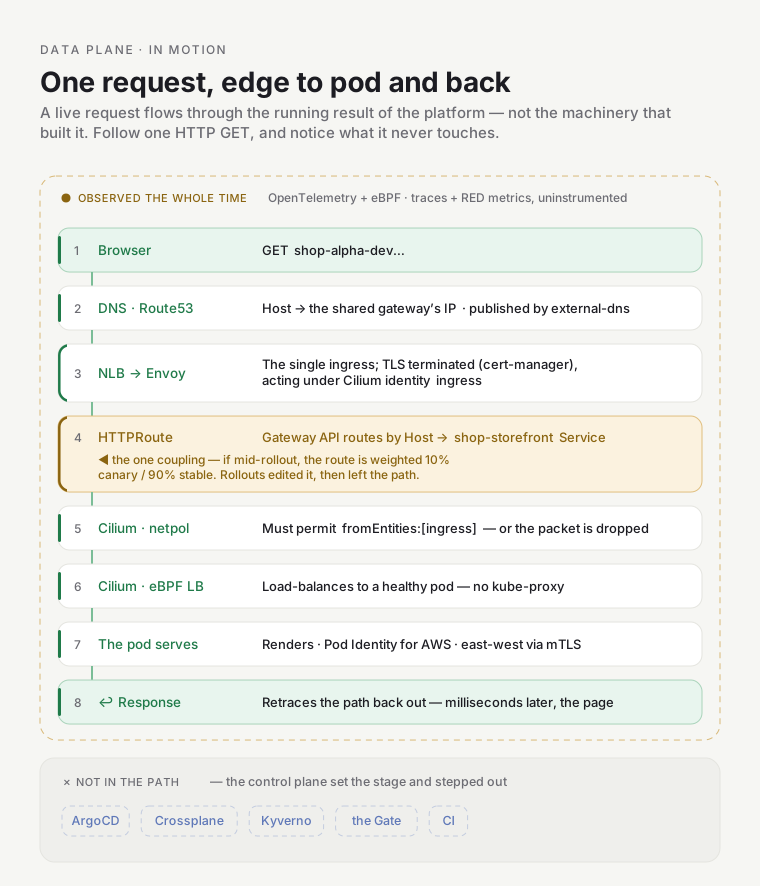
1 · The browser — the request begins. A customer clicks, and their browser fires an HTTP GET for
shop’s storefront service at shop-alpha-dev.preprod.aws.refplat.org. Everything below is the platform
answering that single request.
2 · DNS — finding the door. First that hostname has to become an IP.
That name exists because external-dns published a Route53 record for it when the HTTPRoute was
created, pointing at the cluster’s shared gateway load balancer — one gateway, with a wildcard
*.<domain> listener, fronts every environment’s routes. This is looking up the building’s address before
you drive there. The browser now has an IP: the gateway.
3 · NLB → Envoy — the edge, and TLS opened. The request lands on the gateway’s network load balancer,
which fronts Cilium’s built-in Envoy proxy — the single ingress point for external traffic into the cluster.
The front entrance of the building. (On preprod, tenant apps are internet-facing for external testing and
demos; platform and internal services sit behind a Tailscale-only internal gateway instead — same
machinery, a different door.) Envoy terminates TLS there, using a certificate cert-manager obtained and
auto-renews; from here in, the request travels the cluster’s private network — the courier’s sealed
envelope opened at the front desk by someone authorized to read it. One detail to hold: Envoy acts under a
special reserved Cilium identity, ingress, which matters two steps from now.
4 · The HTTPRoute — the receptionist routes you. Here the Gateway API
does its job. An HTTPRoute matches the request’s Host (shop-alpha-dev…) and path and picks the backend:
shop’s storefront Service. The receptionist reads your appointment and sends you to the right floor.
This is the one place the request touches the deployment story. If shop is mid-rollout, that HTTPRoute is
weighted — Argo Rollouts, through its Gateway-API
traffic-router plugin, has edited the route so that (say) 10% of requests go to the canary version and
90% to stable. So this very request is assigned to canary-or-stable by a weight the control plane set.
Reception waves some visitors into the newly-renovated wing and some into the original, deciding per
visitor. The canary analysis — the Rollout judging this slice’s metrics to
decide whether the new version is healthy — is watching what happens to these exact requests.
The request never spoke to Argo Rollouts, yet a deployment decision steered it. Rollouts expressed that decision by editing the HTTPRoute weights, a data-plane object, then stepped out of the request path. The control plane changes the data plane’s configuration and lets the request follow the weights it finds.
5 · Network policy — the security checkpoint. Before the traffic reaches a pod, Cilium checks its
network policy: is the source — Envoy’s ingress identity — allowed to reach shop-storefront’s pods? The
environment’s CiliumNetworkPolicy must explicitly permit fromEntities: [ingress], or the packet is
dropped. A badge reader at the floor’s entrance: even inside the building, you don’t get in without the
right credential. This is a data-plane wall from the security model —
least-privilege connectivity, enforced on every packet.
6 · Service to pod — the elevator dispatcher. The Service is a ClusterIP, and Cilium — running
kube-proxy replacement in eBPF (there is no
kube-proxy here) — load-balances the connection to one healthy pod of whichever shop-storefront Service
(stable or canary) the weighted HTTPRoute already picked in step 4, honoring the readiness gates. The
dispatcher sends you to an available, staffed floor, never a dark one.
7 · The pod serves — the actual work. Finally the request reaches your application code, and it does the
thing: renders the page. If it needs AWS along the way — read its S3 bucket, enqueue a job — it uses the
credentials it got from Pod Identity (short-lived, scoped, no static keys). If it needs another
service — say it calls a checkout API — that’s an east-west hop, allowed or denied by Cilium network
policy between pods, encrypted on the wire (WireGuard) and, where a policy sets
authentication.mode: required, mutually authenticated so the two services cryptographically prove who
they are (SPIFFE identity via SPIRE). This is the live alpha-shop → alpha-checkout showcase;
fleet-wide enforcement is the remaining step.
Observed the whole time — the envelope around every step, not one of them. The request is being watched without
anyone instrumenting it by hand. OpenTelemetry / eBPF
auto-instrumentation records a trace of the request’s path, RED metrics (rate, errors, duration)
tick up, and logs are captured. Security cameras and a visitor logbook that write themselves. This is the
same data feeding the SLO and — if shop is mid-rollout — the canary analysis deciding whether the new
version lives.
8 · The response — back out the door. The pod’s response retraces the path: back through Cilium, back to Envoy, back out the load balancer, back to the browser. Milliseconds after they clicked, the customer has their page, with no idea any of the above happened. Which is exactly the goal.
Why the two planes being separate is the whole point
Section titled “Why the two planes being separate is the whole point”Line up who was involved in each life and the platform’s most important safety property falls out:
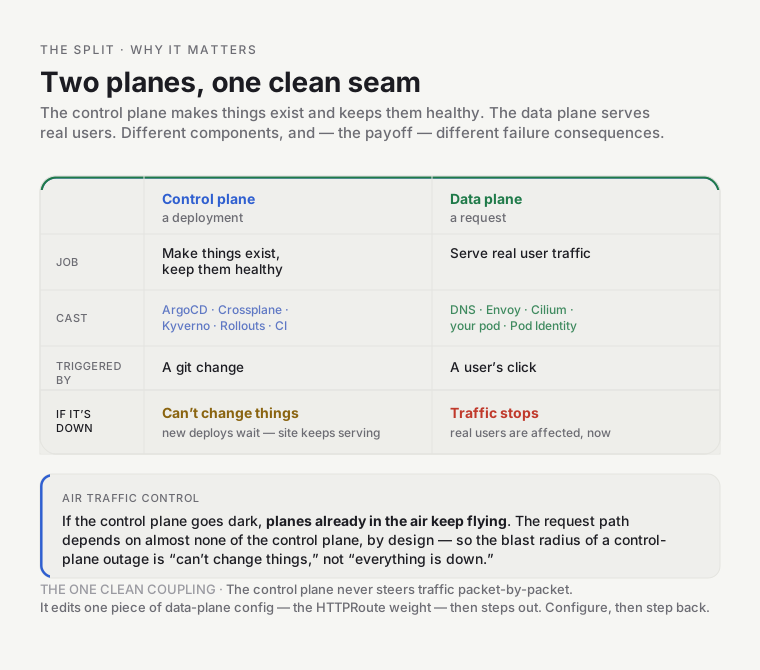
That last row is the payoff — the air-traffic-control metaphor from How the Platform Fits made literal: if the control plane goes dark, planes already in the air keep flying. ArgoCD down? Existing requests still serve — you just can’t deploy. Crossplane down? Running environments still take traffic — you just can’t provision new ones. The request path depends on almost none of the control plane, by design, so the blast radius of a control-plane outage is “can’t change things,” not “everything is down.”
The one deliberate coupling — the HTTPRoute weight — is worth appreciating for how clean it is. The control plane doesn’t sit in the request path steering traffic packet by packet; it edits a piece of data-plane config (the route weights) and lets the data plane carry it out. Configure, then step back — the same instinct as everything else on the platform.
Common mix-ups
Section titled “Common mix-ups”- “The gateway load-balances to my pods.” The gateway (Envoy) routes by Host/path to a Service; Cilium’s eBPF does the actual pod-level load-balancing (there’s no kube-proxy). Two different jobs.
- “Argo Rollouts sits in the traffic path during a canary.” No — it edits the HTTPRoute weight and leaves. The data plane routes each request by the weight it finds; Rollouts just watches the metrics.
- “A request goes through Kyverno.” Kyverno is admission — it gates resources being created, not requests being served. It’s nowhere near the data path.
- “If ArgoCD is down, the site is down.” The site keeps serving; you just can’t deploy changes. Control-plane availability isn’t data-plane availability.
Go deeper
Section titled “Go deeper”- The other half — the control plane in motion: The Life of a Deployment.
- The standing structure both move through: How the Platform Fits (see the control-plane / data-plane boundary) · The Security Model (the data-plane walls: network policy, mTLS gap).
- The planes as full modules (coming — inventory): Ingress & traffic (Gateway API, cert-manager), the cluster & CNI (Cilium), Progressive delivery (Rollouts), Observability.
- The substrate: Gateway API · Cilium · cert-manager · Argo Rollouts · OpenTelemetry.