Learn: Foundations — infrastructure as code (deep dive)
Two tools stand between this platform’s code and the cloud: OpenTofu provisions, Terragrunt orchestrates. This traces the mechanism — how a single leaf unit actually gets its settings, how the two safety asserts fire, where state lives, and how a public repo carries its own secrets. One hard machine, followed end to end. If you’re already fluent in Terragrunt, the Reference is the terse lookup.
The oven and the sous-chef, precisely
Section titled “The oven and the sous-chef, precisely”OpenTofu is the provisioning engine; Terragrunt is the orchestrator wrapped around it — the oven and the sous-chef. The versions both run at are pinned in one place, the single source of truth the whole estate reads from:
# /.tool-versions (read by mise/asdf locally, by CI, and baked into the runner image)opentofu 1.12.1terragrunt 1.0.7kubectl 1.35.5helm 3.21.0awscli 2.35.1root.hcl sets terraform_binary = "tofu", so every terragrunt invocation shells out to OpenTofu 1.12.1 —
never HashiCorp Terraform. Bump a version here and
your laptop, CI, and the self-hosted runner can’t drift apart. That’s the whole point of a canonical pin.
The sous-chef never cooks. Terragrunt generates the backend and provider config, wires units in dependency order, and assembles each unit’s inputs from a layered cascade so no fact is written twice — the cascade the rest of this walks through.
Class and instance: modules vs live units
Section titled “Class and instance: modules vs live units”The code splits two ways, and the split is the class-vs-instance distinction made literal:
infra/modules/— reusable, environment-agnostic OpenTofu modules. How to build an IAM role set, in the abstract. The class.infra/live/aws/— the specific instantiations. The platform account’s IAM roles in us-east-1. The instance.
A live unit never hardcodes a path to its module. There’s one layer of indirection through
infra/live/aws/_versions.hcl, which maps a logical name to a source:
locals { source_base = "${get_repo_root()}/infra/modules" module_source = { iam_roles = "${local.source_base}/aws//iam_roles" eks = "${local.source_base}/aws//eks" # …one entry per module } helm_versions = { cilium = "1.19.4", argocd = "9.5.14", /* … */ }}Today source_base points at the local checkout at HEAD (a monorepo), so every environment runs the same
module code. The comment in that file spells out the future seam: flip source_base to a Terraform-registry
URL and pin each module to a semver tag, and environments can promote module versions independently — without
touching a single unit. The units already ask for module_source.iam_roles; only the map behind the name
would change. Helm chart versions ride the same single-source pattern (helm_versions), so a chart bump is
one edit, not a grep across dozens of units.
The cascade — each fact in exactly one layer
Section titled “The cascade — each fact in exactly one layer”The mechanism, drawn as a CSS cascade: configuration layered by scope, broad to narrow, and each fact lives in exactly one layer.
root.hcl remote state, provider generation, terraform_binary (the whole estate) └─ common.hcl cloud-wide defaults, SOPS secrets, org_name, cost_profile (all of AWS) └─ env.hcl which account, env tags, per-env overrides (one account) └─ region.hcl / network.hcl region + abbrev, CIDRs, subnets (one region) └─ workload.hcl workload name, compliance_tier (one workload) └─ terragrunt.hcl the module + its inputs (one unit)The same layering as a tree — each arrow is one inheritance step, broad scope down to narrow, and _base.hcl is the reader that merges them for the leaf unit:
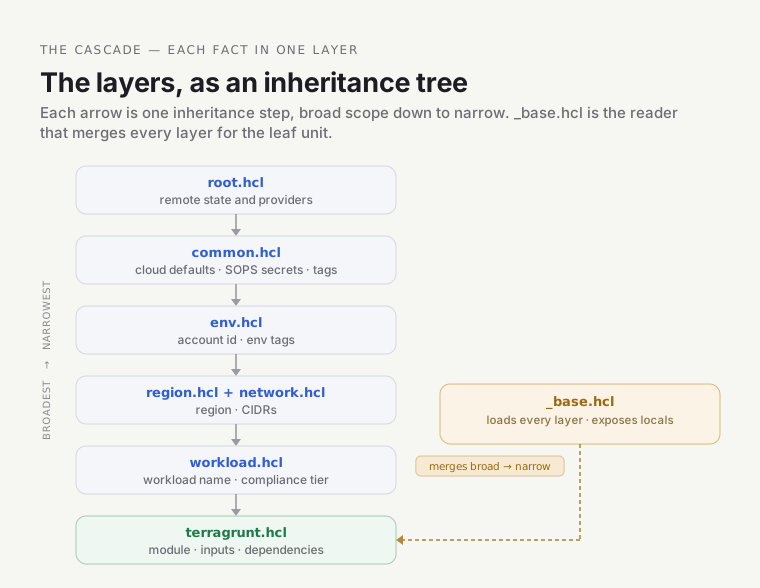
What matters isn’t the nesting — it’s the discipline that each value appears once. A tour of the real files
for the platform hub’s iam-roles unit:
# region.hcl — a region fact, written onceregion = "us-east-1"; region_abbv = "use1"
# network.hcl — the CIDR plan, written once (see the Networking deep dive)vpc_cidr = "10.100.0.0/16"pod_cidr = "10.240.0.0/16"   # Cilium overlay, non-routable
# workload.hcl — the compliance posture, written onceworkload = "platform"; compliance_tier = "standard"
# env.hcl — the account binding, written onceenv = "platform"account_id = local._secrets.account_ids["platform"]   # decrypted, not literal
Change vpc_cidr in that one network.hcl and every unit in the region sees the new value — no
grep-and-replace across directories. That’s the payoff of “each fact in one layer”: there’s exactly one place
to change it, and exactly one place it can be wrong.
How _base.hcl loads the cascade
Section titled “How _base.hcl loads the cascade”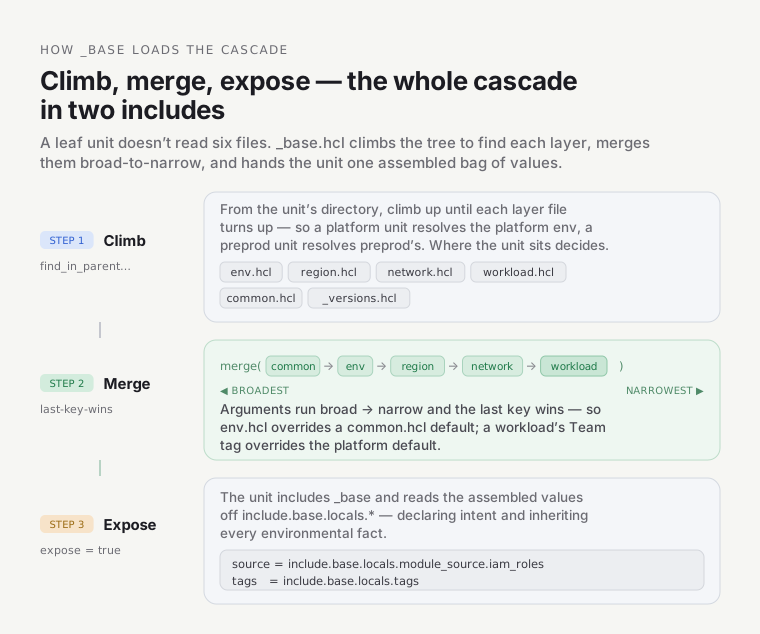
The reader that walks the tree is infra/live/aws/_base.hcl. It doesn’t rely on being told where the layers
are — it searches upward for each one with find_in_parent_folders, then reads it with
read_terragrunt_config:
env_vars = read_terragrunt_config(find_in_parent_folders("env.hcl"))region_vars = read_terragrunt_config(find_in_parent_folders("region.hcl"))network_vars = read_terragrunt_config(find_in_parent_folders("network.hcl"))workload_vars = read_terragrunt_config(find_in_parent_folders("workload.hcl"))common_vars = read_terragrunt_config(find_in_parent_folders("common.hcl"))version_vars = read_terragrunt_config(find_in_parent_folders("aws/_versions.hcl"))find_in_parent_folders("env.hcl") starts in the unit’s directory and climbs until it finds env.hcl — so a
unit deep under platform/us-east-1/platform/iam-roles/ resolves the platform env file, while a preprod
unit resolves preprod’s. Same code, different answer, decided purely by where the unit sits.
Then it does the merge that makes the cascade a cascade — narrowest layer wins:
all_vars = merge( local.common_vars.locals, # broadest local.env_vars.locals, local.region_vars.locals, local.network_vars.locals, local.workload_vars.locals, # narrowest)merge() is last-key-wins, and the arguments run broad→narrow, so an env.hcl value overrides a
common.hcl default for the same key. That’s why common.hcl can set cost_profile = "dev" as a
cloud-wide default while the platform hub’s env.hcl overrides individual knobs (enable_mimir = true,
enable_loki = true) — the env layer wins. The tags follow the identical broad→narrow merge, so a
workload’s Team tag can override the platform default.
How a unit consumes it
Section titled “How a unit consumes it”A leaf unit doesn’t re-read any of that. It includes _base.hcl with expose = true and reads the
pre-assembled values off include.base.locals.*. Here is the top of the platform hub’s IAM-roles unit — the
include and terraform blocks verbatim, the inputs abbreviated (the real inputs opens with create = true, and PlatformAdmin also sets description/max_session_duration):
include "base" {  path   = find_in_parent_folders("aws/_base.hcl")  expose = true}include "root" {  path = find_in_parent_folders("root.hcl")}
terraform {  source = include.base.locals.module_source.iam_roles   # the indirection, resolved}
inputs = {  roles = {    PlatformAdmin = {      trust_principals = { aws = [        "arn:aws:iam::${include.base.locals.account_ids["mgmt"]}:root",        "arn:aws:iam::${include.base.locals.account_ids["platform"]}:root",      ] }      # …    }  }  tags = include.base.locals.tags}
source comes from the resolved module_source map. The trust-policy account numbers come from
include.base.locals.account_ids, which chained all the way back through common.hcl to the decrypted SOPS
file (next section). tags is the four-layer composed map. The unit declares intent — “give PlatformAdmin
these roles” — and inherits every environmental fact. Two include blocks, and the whole cascade is present.
The two SAFETY asserts — refusal by construction
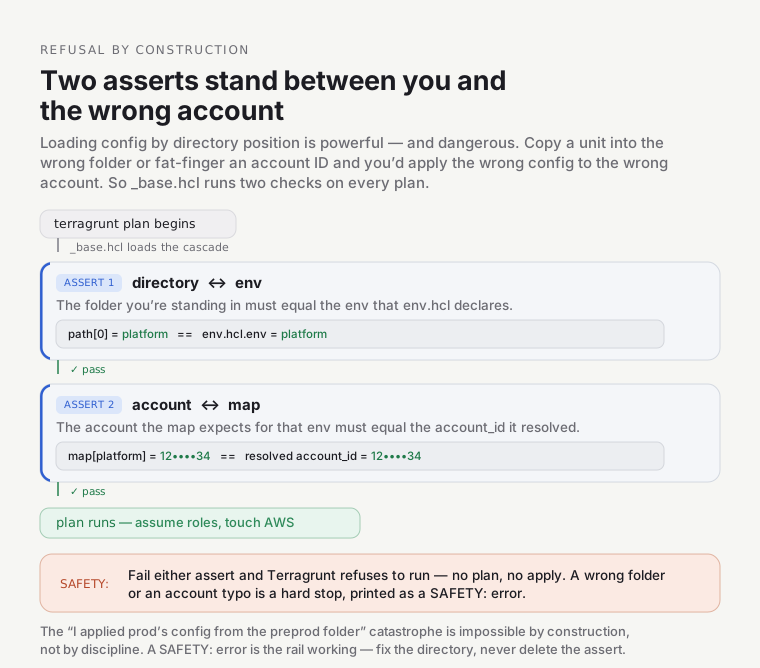
Section titled “The two SAFETY asserts — refusal by construction”Loading the cascade by directory position is powerful and therefore dangerous: copy a unit into the wrong
folder, or fat-finger an account ID, and you’d apply the wrong config to the wrong account. _base.hcl closes
that hole with two assertions that run on every plan, using the classic HCL trick of failing a tobool()
cast with a message when a condition is false:
# 1. the directory you're in must match the env it declares_path_parts = split("/", path_relative_to_include())_path_env   = local._path_parts[0]_assert_env_path = (  local._path_env == local.env ? true  : tobool("SAFETY: directory '${local._path_env}' does not match env.hcl environment '${local.env}'"))
# 2. that env's account ID must match the expected one from the map_expected_account = lookup(local.common_vars.locals.environment_account_map, local.env, null)_assert_account = (  local._expected_account == null || local._expected_account == local.env_vars.locals.account_id  ? true  : tobool("SAFETY: env '${local.env}' expects account '${local._expected_account}' but env.hcl has '…'"))
Assert 1 catches directory/env mismatch — the leaf’s path (platform/us-east-1/platform/iam-roles) starts
with platform, which must equal env.hcl’s declared env. Assert 2 catches an account typo: the
environment_account_map (itself the decrypted account_ids) must agree with the account_id the env file
resolved. Fail either and Terragrunt refuses to run, printing a SAFETY: error. A whole class of
catastrophic copy-paste — the “I applied prod’s config from the preprod folder” mistake — is impossible by
construction, not by discipline. If you ever see a SAFETY: error, that’s the rail working. Fix the
directory or the account map; never delete the assert.
Remote state — where the truth is kept
Section titled “Remote state — where the truth is kept”Every unit’s state is stored remotely, configured once in root.hcl and generated into each unit as a
backend.tf:
remote_state { backend = "s3" config = { bucket = local._secrets.state_bucket key = "${path_relative_to_include()}/terraform.tfstate" region = "us-east-1" encrypt = true dynamodb_table = "terraform-locks" role_arn = local._secrets.state_role_arn # TerraformStateAccess, in the management account }}Three things worth understanding. The key is the unit’s path — path_relative_to_include() yields the
unit’s directory within the repo, so the state layout on S3 mirrors the infra/live/ tree one-to-one; each
unit owns an isolated state object. The lock lives in DynamoDB — a single table, terraform-locks, whose
LockID item a plan/apply grabs so two runs can’t corrupt the same state. Verified live in the management
account:
$ AWS_PROFILE=management aws dynamodb describe-table --table-name terraform-locks \ --query 'Table.{Name:TableName,Status:TableStatus,Keys:KeySchema[].AttributeName}'{ "Name": "terraform-locks", "Status": "ACTIVE", "Keys": [ "LockID" ] }And state access is its own cross-account role — role_arn assumes TerraformStateAccess in the
management account, so reaching state is a separate, auditable identity from the PlatformDeployer role the
providers assume to actually touch AWS. State is the crown jewels (it holds resource metadata and any
sensitive outputs); putting it in the governance account behind its own role keeps a runaway apply in a spoke
from ever rewriting another environment’s state.
SOPS — the locked glass case in the public square
Section titled “SOPS — the locked glass case in the public square”The trick: this is a public repository, yet the account IDs, emails, SSO URLs, state-bucket name, and
state-role ARN are committed right in git. They live in infra/live/aws/secrets.enc.yaml, encrypted
per-value with SOPS against a dedicated
AWS KMS key. A raw line looks like this:
account_ids: platform: ENC[AES256_GCM,data:8buQRHB7pLkwakxM,iv:gAu8bJ/…,tag:…,type:str]common.hcl decrypts the whole file inline, in memory at config-eval time — using Terragrunt’s built-in
sops_decrypt_file, which calls KMS with your ambient AWS identity (before any provider assume-role):
_secrets = get_env("TG_SOPS_BOOTSTRAP", "") == "1" ? read_terragrunt_config("${get_repo_root()}/infra/live/aws/secrets.hcl").locals : yamldecode(sops_decrypt_file("${get_repo_root()}/infra/live/aws/secrets.enc.yaml"))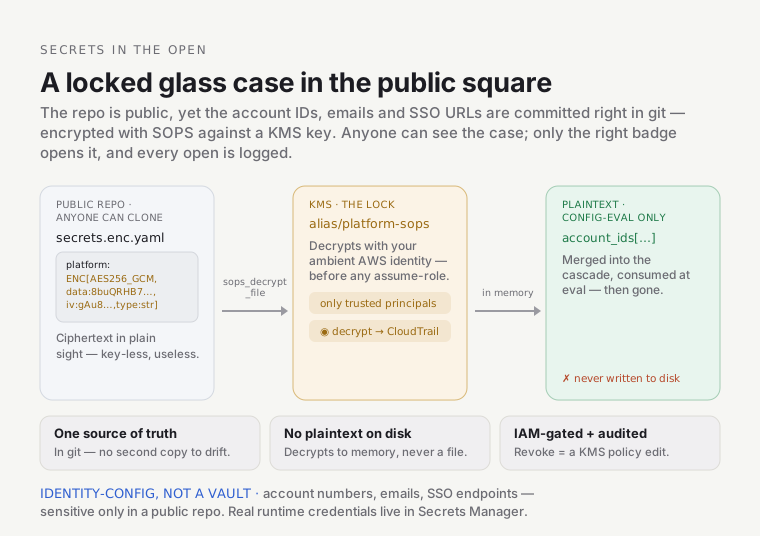
Which KMS key is pinned by .sops.yaml at the repo root (account ID and key UUID redacted here):
creation_rules: - path_regex: infra/live/aws/secrets\.enc\.yaml$ kms: "arn:aws:kms:us-east-1:<mgmt-account-id>:key/<sops-key-uuid>"That key exists — verified live, resolved through its human-readable alias:
$ AWS_PROFILE=management aws kms list-aliases \ --query "Aliases[?AliasName=='alias/platform-sops'].AliasName" --output textalias/platform-sopsThis is the locked glass case in the public square. Anyone can clone the repo and see the ciphertext; only a
principal the KMS key policy trusts — the SSO AdministratorAccess roles, and the ARC runner role — can
decrypt it, and every decrypt is a CloudTrail event. The why is worth stating plainly, because the
design weighed and rejected the tempting alternatives:
- Single source of truth, zero drift. The config is in git. There is no second copy in a secrets store to fall out of sync with each operator’s laptop — the drift problem that disqualified the “materialize it in CI” option.
- No plaintext on disk, ever.
sops_decrypt_filedecrypts to memory; nothing is written on a laptop or a runner. Compare a gitignored plaintextsecrets.hcl, which would live in cleartext on every machine. - IAM-gated + audited, KMS not
age. Access is a KMS key policy, so every principal that needs to decrypt already has an AWS identity — no key material to distribute (the exact problemagereintroduces). Revoking an operator is a policy edit.
One nuance: secrets.enc.yaml holds no actual credentials — no passwords or tokens. Real runtime secrets
live in AWS Secrets Manager and are pulled by External Secrets. This file holds only environment-identifying
values that are merely sensitive-in-a-public-repo (account numbers, emails, SSO endpoints). It’s an
identity-config file, encrypted; not a vault.
The bootstrap chicken-and-eggs
Section titled “The bootstrap chicken-and-eggs”Both pillars above have the same circularity, and it’s the thing that most surprises people. Every unit’s
config load now (a) writes state to the S3 bucket and (b) decrypts secrets.enc.yaml with the KMS key. So how
do you create the bucket and the key, when creating them would itself require… the bucket and the key?
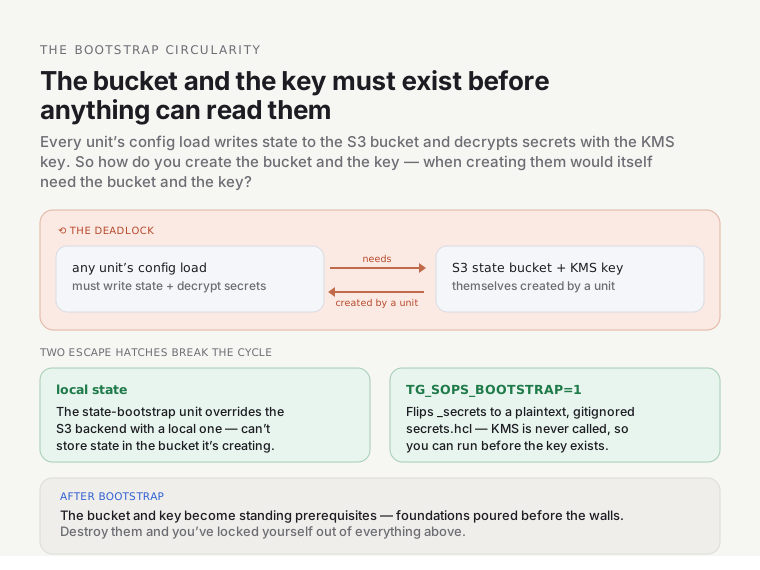
You can’t — from a normal unit. So both are bootstrap-tier: created once, outside the secrets-reading flow, before anything else exists. Two escape hatches make this work:
- Local state for the bootstrap unit.
root.hcl’s comment notes thestate-bootstrapmodule overrides the S3 backend with a local backend — it can’t store its state in the bucket it’s busy creating. TG_SOPS_BOOTSTRAP=1. Set this env var and every_secretsload falls back to a plaintext, gitignoredsecrets.hclinstead of calling KMS — the only way to run beforealias/platform-sopsexists. Terragrunt short-circuits the conditional, so the un-taken branch’s file is never even read. This is a true-from-zero greenfield escape only; in steady state it’s off, and the encrypted file is authoritative.
After bootstrap, the bucket and the key are standing prerequisites, like foundations poured before the walls. The teardown/rebuild runbook treats them specially for exactly this reason: destroy them and you’ve locked yourself out of everything above.
Gotchas that teach
Section titled “Gotchas that teach”- A
SAFETY:refusal is the rail working, not a bug. It means the directory doesn’t matchenv.hcl, or an account ID in the map disagrees with the env file. Fix the directory or the account binding — disabling the assert is disabling the one check that stops a cross-account apply. - The
versionsfallback inroot.hclis dead code on purpose. Its generatedversions.tfis set toif_exists = "skip", because every shared module ships its ownversions.tf. A generatedversions.tfthat pinnedaws = "6.47.0"exactly here would be silently skipped — units resolve the module’s looser bound instead. Lesson: a generated file that “looks” authoritative may be skipped; the module’s ownversions.tfwins. role_arnon state is not the deployer role. Reaching state assumesTerraformStateAccess(management); touching AWS assumesPlatformDeployer(per-env). Two different identities in the same run — by design, so state lives behind a separate wall.- The provider assume is conditional.
root.hclonly injects thePlatformDeployerassume-role when the caller’s account differs from the target — which is true for an operator running frommanagement, but not for the in-VPC ARC runner (it lives in the platform account).TG_FORCE_DEPLOYER=1forces the assume so the runner faithfully stands in for the operator’s cross-account identity. - Editing secrets means editing with
sops. You can’t just opensecrets.enc.yaml— runsops infra/live/aws/secrets.enc.yaml, which decrypts to your$EDITORand re-encrypts on save. A malformed edit fails the re-encrypt rather than committing broken ciphertext.
Go deeper
Section titled “Go deeper”- Source:
infra/root.hcl,infra/live/aws/{common,_base,_versions}.hcl,infra/live/aws/secrets.enc.yaml,.sops.yaml, and any leafinfra/live/aws/**/terragrunt.hcl. - House skills: terragrunt-units (authoring units), terraform-style (module
.tf), apply-and-destroy (running plans/applies), platctl (bootstrap/teardown orchestration). - Back to the Foundations orientation · sideways to the
Account model deep dive (the
TerraformStateAccess/PlatformDeployerrole model in full).