The Life of a Deployment
The question
Section titled “The question”You’re a developer on the alpha team. You fix a one-line bug in the shop product’s storefront service, open
a PR, and merge it. You go make coffee. By the time you’re back, the fix is serving real users.
What actually happened in those few minutes? Not the tidy arrows on an architecture slide — the real chain of machinery, plane by plane, and who did what and why. The honest answer is surprising, and once you see it the whole platform stops feeling like magic and starts feeling like a system you could reason about at 3 a.m. during an incident.
This doc is that answer: one git push, followed all the way to a running pod, teaching each plane it
touches as we go. It’s long on purpose — that’s the right length for the thing that connects everything
else.
The one idea: there is no conductor
Section titled “The one idea: there is no conductor”Start by throwing away the mental model you almost certainly have. Most people picture something like this:
a conveyor belt. Your code is a package. You drop it on the belt, and a big build-and-deploy robot carries it from station to station — build, test, ship — until it pops out the far end, running in production. One machine, one pipeline, pushing your work along.
There is no belt. There is no robot. Nothing pushes your code anywhere.
What’s actually there is a room full of thermostats. Take one — Crossplane, the control plane behind the Environment API: it sits there watching desired state versus actual state and quietly closes the gap whenever they drift, forever, without being asked. That wasn’t a one-off. That is how the entire platform is built. A dozen different control planes, each a thermostat for its own concern: each watches one thing — either the git repository or the live cluster — and reconciles its own slice of your intent toward what you declared.
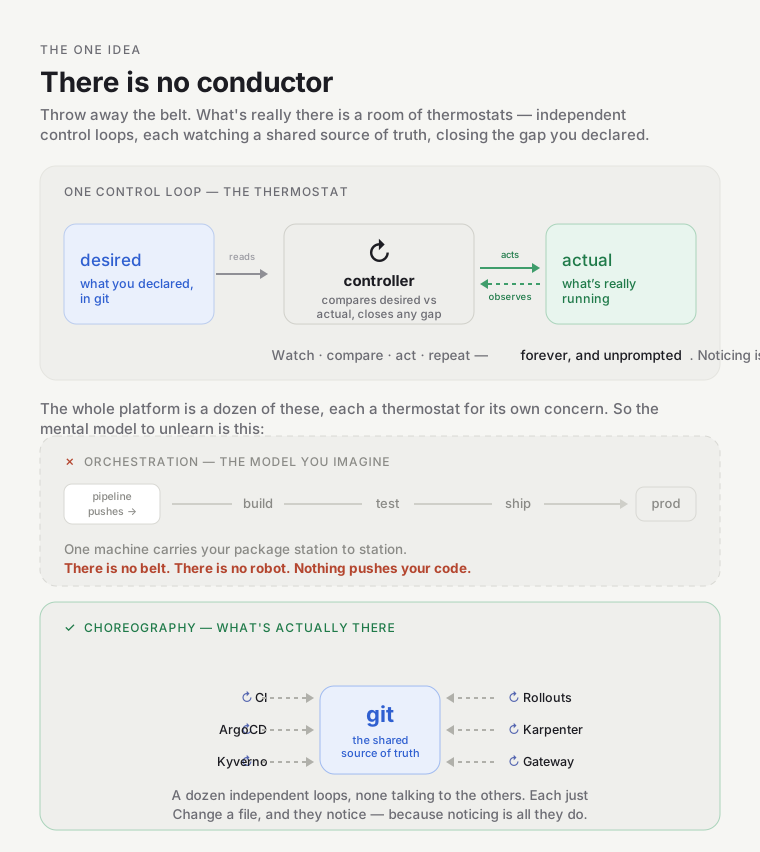
Your deployment is not a package riding a belt. It’s what you observe when, one after another, each of these thermostats notices its cue and acts.
And the thing they all watch — the shared source of truth that coordinates the whole dance without any of them talking to each other — is git. You never call these planes. You never trigger a pipeline. You change a file in git, and they notice, because noticing is the only thing they do. This pattern has a name — GitOps: the desired state of the system lives in git, and automated agents continuously make reality match it.
That’s the whole idea, and it’s worth saying plainly, because everything below is just this idea playing out ten times:
The platform is choreography, not orchestration. No central conductor pushes work through stages. Independent control loops each react to a shared source of truth (git) and converge the world toward it.
Where the thermostat picture breaks (metaphors always do — say how, or they mislead): a real thermostat watches a smooth, continuous value — temperature — and nudges gently. These watch discrete desired state — a specific manifest, an exact image — and either it matches or it doesn’t. And “a room of thermostats” makes it sound like they take turns; they don’t. Every plane runs continuously and in parallel, all the time. The order you’re about to walk through is simply the order in which each plane’s cue happens to arrive. Keep those two caveats and the metaphor will carry you the whole way.
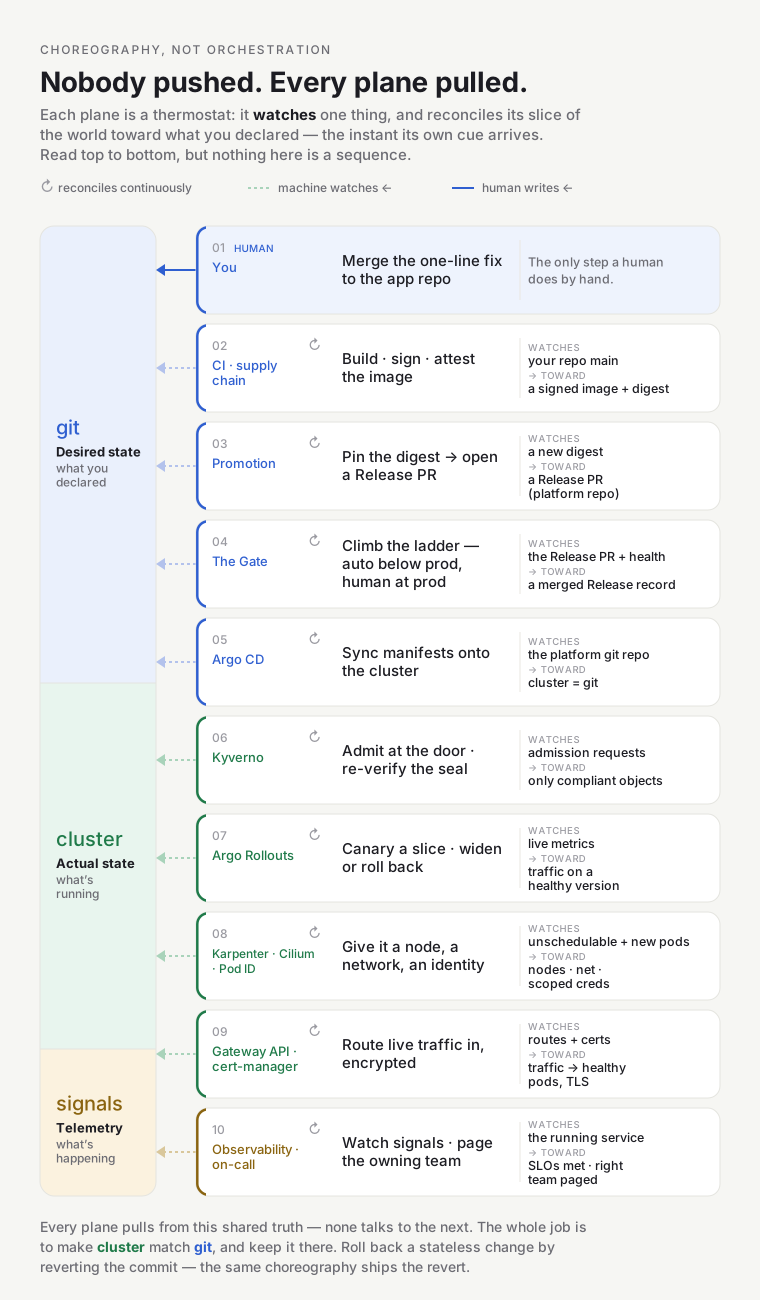
Ten planes. We’ll walk each — what it does, why it exists, the idea it’s built on — following the storefront
service of alpha’s shop from your merge to live traffic.
1 · You merge (your repo)
Section titled “1 · You merge (your repo)”Your PR lands on main in asanexample/alpha-shop. That’s it. That is the last thing a human does by
hand in this entire story (well — until a human chooses to approve the production release near the end).
Everything from here is a machine noticing that something changed.
Notice how unusual that is. You didn’t run a deploy command. You didn’t open a dashboard and click “ship.” You didn’t file a ticket for ops. You changed code and merged it — the same thing you’d do on a solo hobby project — and the platform took it from there. That’s the point of a platform: turn “deploy to a compliant, observable, multi-account, progressively-delivered production environment” into “merge your PR.” Everything below is the machinery that makes that trade honest.
2 · CI builds, signs, and attests it (the supply chain)
Section titled “2 · CI builds, signs, and attests it (the supply chain)”The moment your merge lands, your repo’s CI wakes up. But notice what it is: your repo’s workflow is a thin caller of shared workflows the platform owns — you don’t copy-paste a hundred lines of Docker-and-security YAML into every app; you call the platform’s versions and inherit their guarantees. (This is the paved-road idea: the safe path is the easy path.)
Your CI thinly calls two shared workflows, which together do three things:
- Builds your code into a container image (build-sign workflow).
- Pushes it to the platform’s registry as
team-alpha/shop-storefront@sha256:…, then cosign-signs it and records a software bill of materials (still the build-sign workflow). - Attests it — a separate, isolated provenance workflow writes the SLSA build attestation from its own identity. This is the part worth teaching, because it’s the platform’s answer to a whole category of attack.
The problem it solves: a container image is just a blob in a registry. How does the cluster, later, know that a given blob is really your code, built by your CI from your repo — and not something a compromised laptop or a poisoned dependency slipped in? You can’t just trust the name; names can be overwritten.
So the workflow cosign-signs the image. Cosign
does keyless signing: instead of a secret key someone could steal, it uses CI’s own short-lived OIDC
identity (the GitHub Actions run proving “I am the build-sign workflow of this repo”) to produce a
signature, and records it in a public transparency log. Then a separate, isolated provenance workflow writes a
SLSA provenance attestation — a signed statement describing how and where this
image was built (which repo, which commit, which workflow). Keeping provenance in its own workflow and identity
is what earns the SLSA L3 “isolated builder” guarantee.
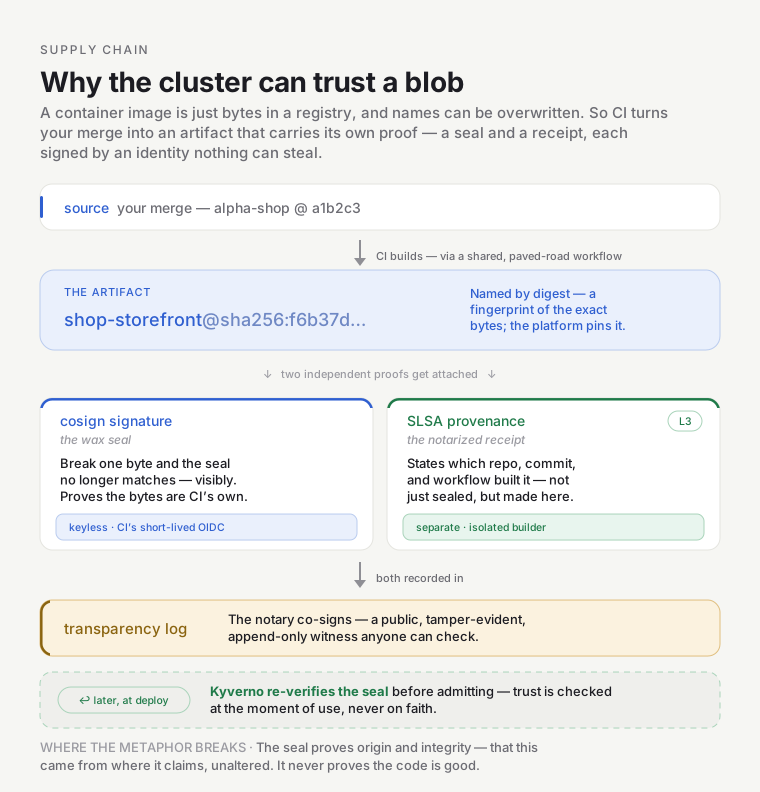
Think of it as a tamper-evident wax seal plus a notarized receipt. The signature is the seal: break it — alter one byte of the image — and the seal doesn’t match, visibly. The provenance is the notarized receipt: it doesn’t just say “this is sealed,” it says “made by this workshop, from these materials, on this date,” and a notary (the transparency log) co-signed it. Where the metaphor breaks: a seal proves origin and integrity, not quality — a perfectly-sealed image can still be full of bugs. The seal answers “did this come from where it claims?”, never “is the code good?”
Nothing is deployed yet. This stage’s only job is to turn your merge into a trustworthy artifact and its digest — a value we’re about to lean on hard.
Its own module: Supply chain — keyless signing, isolated SLSA provenance, the thin-caller model, verify-at-admission.
3 · The digest is promoted — into a different repo
Section titled “3 · The digest is promoted — into a different repo”This is the first place the platform diverges from what you’d expect.
First, why a digest? The image has a name (team-alpha/shop-storefront) and it could have a tag (:latest,
:v1.2). But tags are mutable nicknames — :latest can point at one image today and a different one
tomorrow; two people saying “latest” can mean two different things. A digest (sha256:f6b37d…) is a
content fingerprint: it’s computed from the image’s bytes, so it names one exact image, forever.
Deploy a tag and you’re trusting a nickname; deploy a digest and you’re pinning a fingerprint. The platform
deploys digests. (More on image references.)
Second, where does that digest go? Not back into your app repo. A promote step opens a pull request on
the platform repo — a completely different repository — editing exactly one file: the product’s Release
record for this stage.
# gitops/releases/alpha/shop/dev.yaml (in the PLATFORM repo, not yours)apiVersion: platform.refplat.org/v1beta1kind: Releasespec: environmentRef: alpha-shop-dev services: storefront: digest: sha256:f6b37d… # ← the freshly built, signed image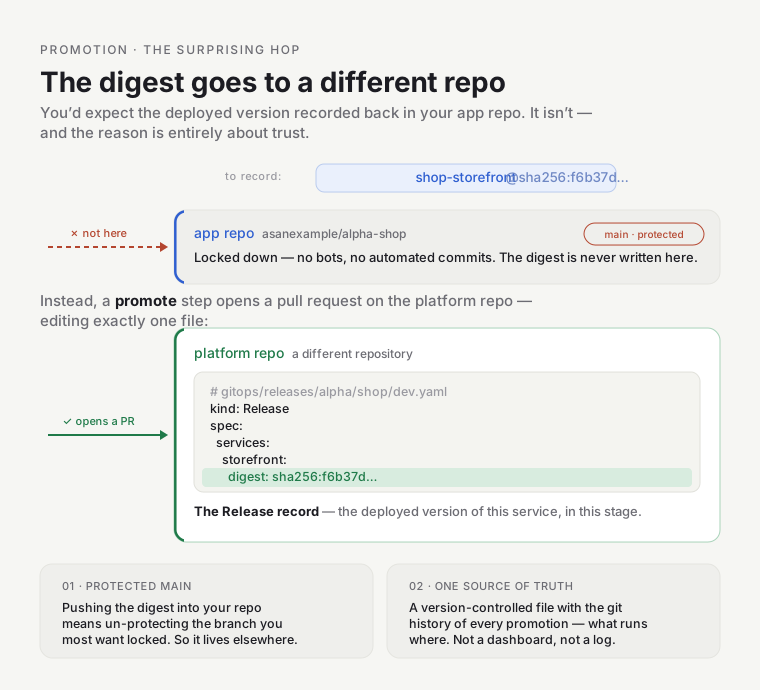
Why go to all that trouble to write a digest into a foreign repo? Two reasons, both about trust:
- Your
mainstays protected. Your app repo’smainbranch is locked down — no automated commits, no bots pushing to it. If deployment worked by having CI push a digest back into your repo, you’d have to un-protect the branch you most want protected. So the deployed digest lives elsewhere. - One auditable source of truth for “what is running where.” That
Releasefile is the record of the deployed version ofalpha-shop’sstorefrontin dev. Not a dashboard, not a log — a version-controlled file with a full git history of every promotion.
4 · The Gate merges it (the promotion ladder)
Section titled “4 · The Gate merges it (the promotion ladder)”That Release PR doesn’t merge itself blindly. A gitops “Gate” reviews it. And here the platform encodes a piece of hard-won operational wisdom: not all environments deserve the same trust.
Up through staging, the Gate auto-merges the promotion once health checks pass — dev, test, uat, staging all flow automatically, because a bad change there hurts no real user. At prod, the Gate stops and waits for a human release-approver to sign off. Same image, the exact same signed digest, climbing rung by rung:
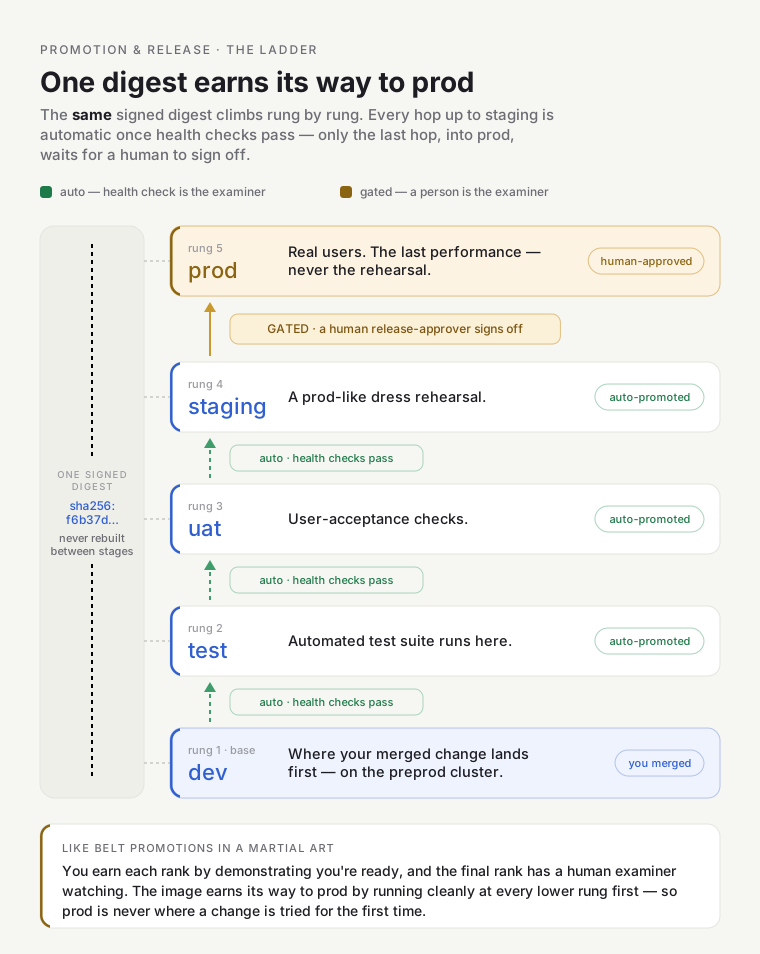
Everything up to staging promotes automatically once health checks pass; only the last hop, into prod, waits for a human release-approver.
Think of it as belt promotions in a martial art. You don’t award a black belt to someone who just walked in. You earn each rank by demonstrating you’re ready, and the final rank has a human examiner watching. The image “earns its way” to prod by running cleanly at every lower stage first — so prod is never the place a change is tried for the first time. Where it breaks: unlike belts, a promotion can be automatic below prod — the “examiner” for the lower rungs is a health check, not a person.
Our dev change is at the bottom rung, so it auto-merges. The digest is now committed to the platform
repo’s main. Which means: git has changed. And something is always watching git.
Its own module, later: Promotion & release — the full ladder, Release-keyed delivery, the approver role. Source: Promotion & Release.
5 · ArgoCD notices, and syncs (delivery)
Section titled “5 · ArgoCD notices, and syncs (delivery)”Nobody told ArgoCD to deploy anything — and that’s the GitOps idea made concrete. ArgoCD’s entire job is to continuously compare the cluster to git and fix any difference. The merged Release is a difference. So ArgoCD reconciles it, unprompted, the same way the thermostat in your hallway doesn’t wait for permission to notice the room got cold.
Mechanically: a per-Product ApplicationSet turns each Release record into one ArgoCD Application. That
Application pulls your service’s Kubernetes manifests from your app repo’s k8s/overlays/dev folder — and
injects the promoted digest over the :placeholder the overlay ships with. (So your overlay never has
to contain a real digest either; the platform supplies it at sync time from the Release.) ArgoCD then
applies the finished manifests to the alpha-shop-dev namespace on the preprod cluster.
Look at what was already sitting there, waiting for this workload to arrive: the alpha-shop-dev
namespace, its dedicated image registry, its scoped AWS permissions, its network policies and resource
quotas. None of that was created just now. The Environment API
provisioned it earlier — when the Environment was first declared — using the very same reconcile-toward-
git pattern. This deploy isn’t building a house; it’s a tenant moving into a house that was already built,
inspected, and furnished. (That’s the whole “provision once, deploy many times” split from the domain
model.)
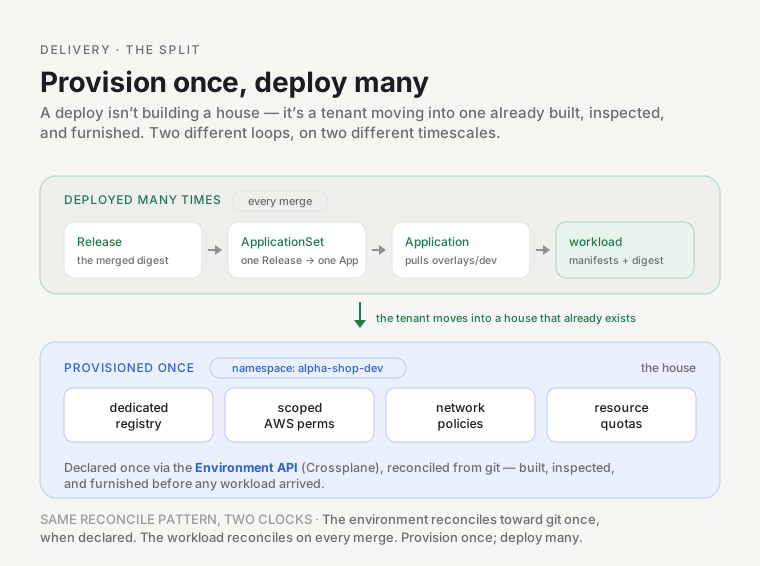
Its own module: Delivery — ArgoCD, ApplicationSets, the promotion ladder, and Rollouts, in depth.
6 · Kyverno admits it (policy)
Section titled “6 · Kyverno admits it (policy)”The manifests reach the cluster’s API server — and immediately hit a checkpoint they must clear before they can exist: admission control. Every single object that tries to enter a Kubernetes cluster passes through admission first; it’s a built-in gate at the door of the API. The platform puts a policy engine, Kyverno, on that gate.
It’s passport control at a border. Everything arriving has to present its papers. Kyverno inspects them against the rules and does two kinds of thing: it turns away anything that violates a hard rule, and it stamps in the compliant travellers — sometimes adding a required stamp they forgot. Where it breaks: border control checks your documents, not whether you’re a good person; Kyverno checks that a workload is compliant, not that your app works.
What it rejects your deploy for (a partial list): an image from another team’s registry; an image that isn’t signed and attested (yes — it re-verifies, at deploy time, the very signature CI made in step 2, because trust is checked at the moment of use, not taken on faith); missing resource limits or health probes; a hostname the Environment isn’t allowed to claim; in prod, fewer than two replicas. Fail any of these and the workload never runs — it’s stopped here, at the door, with a clear error, instead of half-deploying and paging someone at midnight.
What it quietly adds for you (so every workload is safe-by-default without every developer remembering every rule): a locked-down security context, a PodDisruptionBudget so it can’t be drained to zero, topology spread so its replicas don’t all land on one node. You write the interesting 80% of the manifest; the platform fills in the safety boilerplate.
This is policy as code: the rules that used to live in a wiki page nobody read, or in a reviewer’s head, are executable and enforced identically every time, on every cluster.
Its own module: Policy & admission — Kyverno, the three verbs (validate/mutate/generate), the catalog, audit→enforce.
7 · The Rollout canaries it (progressive delivery)
Section titled “7 · The Rollout canaries it (progressive delivery)”Admitted — but not yet live to everyone. Because your workload isn’t a plain Kubernetes Deployment that swaps all its pods at once. It’s an Argo Rollout, and it deploys cautiously, on every stage — not just prod.
Instead of replacing all the old pods with new ones in one move (and betting the whole service on the new version being good), a Rollout brings up the new version alongside the old and shifts only a slice of traffic to it — say 10%. Then it watches the metrics for that slice: error rate, latency, whatever the service’s SLO cares about. Healthy? It widens the slice — 25%, 50%, 100% — step by step. Unhealthy? It automatically rolls back to the old version, no human, no page.
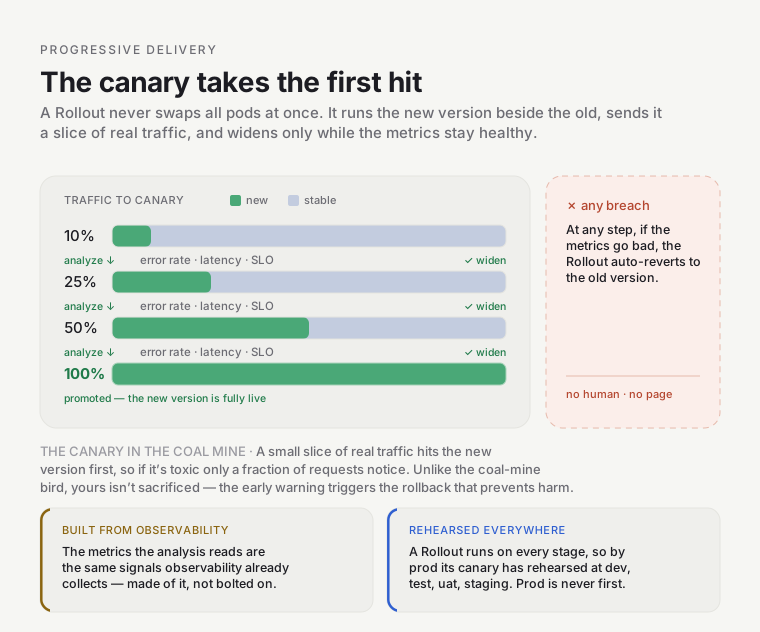
This is, literally, the canary in the coal mine. Miners carried a canary underground because the small bird succumbed to invisible gas before the humans did — an early, contained warning. Your canary pod is the same: it takes a little real traffic so that if the new version is toxic, a small fraction of requests notice before everyone does. Where it breaks (and it’s the humane part): the coal-mine canary was sacrificed; yours isn’t. When the canary detects trouble, the Rollout rolls it back — the whole point is that the early warning prevents the harm rather than just marking it.
Notice the loop closing here: the metrics the canary analysis uses to decide “healthy or not?” are the same signals we’re about to see the observability plane collect in step 10. Progressive delivery isn’t a separate safety system bolted on — it’s built out of the observability the platform already has. And because a Rollout runs on every stage, by the time a change reaches prod its canary logic has already rehearsed at dev, test, uat, and staging. Prod is the last performance, never the dress rehearsal.
Its own module, later: Progressive delivery (Argo Rollouts, metric analysis, auto-rollback).
8 · It gets a machine to run on (the substrate)
Section titled “8 · It gets a machine to run on (the substrate)”The new pods need somewhere to actually execute, a network to speak on, and an identity to act as. Three more planes engage, each watching for its own cue.
- A node to run on. If the cluster has spare capacity, great. If not, Karpenter — watching for unschedulable pods — provisions a right-sized EC2 node in seconds, just for them, and removes it later when it’s idle. Think of it as a restaurant that doesn’t keep a hall full of empty tables heated all night — it sets a table the moment a party arrives, and clears it when they leave. Just-in-time capacity instead of a standing, costly reservation. (What made the pods unschedulable? Often the service’s default HPA scaling replicas up under load — more pods than the current nodes can hold. When load falls the HPA scales them back down, and Karpenter consolidates the now-idle node away: the same loop run in reverse.)
- A network to speak on. Cilium, the cluster’s CNI (Container Network Interface), wires the new pod into the pod network — assigns it an address, and enforces which other pods it’s allowed to talk to. It’s the switchboard: it connects your pod’s line into the exchange and honors the rules about who may call whom.
- An identity to act as. Your
shopcode needs to reach its AWS resources — an S3 bucket, a queue. It gets those credentials through EKS Pod Identity: the pod assumes a scoped AWS role through its ServiceAccount, with no static keys baked into the image or a secret. It’s a visitor badge, not a copied master key — issued on arrival, scoped to exactly what this workload may touch, and it expires. Nothing to leak, nothing to rotate, nothing to steal from a repo.
Their own modules, later: Nodes & compute (Karpenter), The cluster & CNI (Cilium), Workload identity (Pod Identity).
9 · Traffic finds it (ingress)
Section titled “9 · Traffic finds it (ingress)”The pods are running and healthy — but the internet can’t reach them yet. That last hop is ingress, and
the platform routes it through the Gateway API (the modern
successor to Kubernetes Ingress). A resource called an HTTPRoute maps the Environment’s public
hostname — shop-alpha-dev.preprod.aws.refplat.org, which the Environment API generated and which Kyverno
just confirmed this team is allowed to use — to your service.
External requests arrive at the cluster’s gateway (Cilium’s built-in Envoy proxy), where TLS is terminated using a certificate that cert-manager obtained and renews automatically — no one files a ticket for a cert. From there the request is routed to one of your healthy pods.
Picture a large office’s front desk. Visitors don’t wander the building looking for the right room; they arrive at reception, which knows the directory (“
shop-alpha-dev→ thestorefrontteam’s floor”) and sends them to the right place. TLS is the sealed courier envelope the message travels in so nobody can read or tamper with it on the way. The HTTPRoute is the line in reception’s directory; cert-manager keeps the envelopes stocked.
The fix is now live — reachable, encrypted, routed only to healthy pods.
Its own module, later: Ingress & traffic (Gateway API, cert-manager, the hostname convention).
10 · Everything watches it (observability & on-call)
Section titled “10 · Everything watches it (observability & on-call)”The deploy “finished” — but the platform’s attention doesn’t move on. From its first breath, the pod emits signals: metrics (how many requests, how fast, how many errors), traces (the path of a request across services), logs, and profiles. A lot of this is collected automatically, without you hand-instrumenting much, because the platform’s observability stack watches every workload. (The open standard underneath is OpenTelemetry.)
This is the same stream of data the Rollout’s canary analysis used three steps ago to decide the new version was safe. Observability isn’t a passive dashboard you check after the fact — it’s the platform’s live nervous system, feeding decisions in real time.
It’s the cockpit instruments of the platform. You cannot fly a modern aircraft by looking out the window; you fly it on instruments that tell you attitude, altitude, and airspeed continuously. The service’s dashboards, traces, and SLOs are those instruments — and, like a stall-warning horn, some of them are wired to act.
Which is the last loop: those signals feed SLOs (service-level objectives — an explicit target like
“99.9% of requests succeed”). If a service starts burning through its error budget too fast, an alert
fires and routes to alpha’s on-call — the platform knows which team owns this workload and pages
them, not a generic ops pager — and the triage copilot may post a first-pass diagnosis before a human
even opens their laptop. (SLO-based alerting is a whole
discipline; the platform bakes it in.)
The loop never truly closes. Long after your merge, every thermostat is still running, still watching.
Their own modules, later: Observability (the stack, the four signals, SLOs), On-call & owner routing (PagerDuty, the triage copilot).
The real insight: nobody pushed
Section titled “The real insight: nobody pushed”Walk back over those ten steps and notice the thing that was true at every one of them: nothing pushed your code forward. There was no pipeline carrying a package. Each plane pulled, independently, the instant its own cue appeared:
| Plane | Watches… | Reconciles toward… |
|---|---|---|
| CI / supply chain | your repo’s main |
a signed, attested image + its digest |
| Promotion / the Gate | a new digest | a merged Release record |
| ArgoCD | the platform git repo | the cluster matching git |
| Kyverno | admission requests | only compliant resources existing |
| Argo Rollouts | the Rollout + live metrics | traffic on a healthy version |
| Karpenter | unschedulable pods | enough nodes, no waste |
| Cilium / Pod Identity | new pods | networking + scoped credentials |
| Gateway / cert-manager | routes + certs | traffic reaching healthy pods, encrypted |
| Observability / on-call | the running service | signals, SLOs, the right team paged |
This is why the platform is resilient rather than fragile. There’s no single pipeline whose failure stops everything, because there is no single pipeline. Kill a pod and the Rollout replaces it. Hand-edit a live resource and ArgoCD reverts it to match git. Let a node die and Karpenter makes another. Drift anything from its declared desired state and the thermostat responsible for that concern drives it back — no human, no runbook, no page. You don’t operate this platform by pushing things through it. You operate it by changing the desired state in git and letting the loops converge.
That’s also why “how do I roll back?” has a boring, wonderful answer — for a stateless change: revert the git commit, and the same choreography that shipped it ships the revert.
The honest limit of that story is data. Reverting the commit reverts the code, not the schema. A release that ran a database migration can’t be undone by reverting code alone — the schema already changed, and down-migrations are often lossy or impossible. In fact the platform’s own canary (step 7) already runs two app versions against the same database at once, so it quietly assumes every schema change is backward-compatible with the previous version — a contract nothing here yet enforces or even writes down. Making applications genuinely rollback-resilient — additive expand/contract migrations, decoupled from the deploy — is a real frontier this platform still owes itself. We name it plainly rather than pretend the git-revert answer stretches to cover your data too.
Common mix-ups
Section titled “Common mix-ups”- “CI deployed my code.” CI built and signed it; CI never touches a cluster. The deploy was ArgoCD reconciling a git change — a different plane entirely, and it only ran because git changed, not because CI called it.
- “The running digest lives in my app repo.” It lives in the platform repo’s
Releaserecord. Yourmainstays protected and free of CI commits — on purpose. - “Canaries are a prod thing.” Every stage deploys as a Rollout with canary logic; prod is just the last, human-gated rung of a ladder the change already climbed cleanly.
- “Signing at build time is what keeps prod safe.” Signing is only half of it — the other half is verifying at admission. A signature nothing checks protects nothing; Kyverno is the check.
- “Something orchestrates all this.” Nothing does. Independent loops share one git source of truth. Remove any single one and the others wouldn’t even notice the “conductor” is gone — because there never was one.
Go deeper
Section titled “Go deeper”The same structure at rest — the standing map these planes form, and where each one physically runs: How the Platform Fits.
The other half in motion — a live user request through the data plane (vs. this deploy through the control plane): The Life of a Request.
The planes as full modules (built, or coming — each zooms in on one step above):
- The Environment API — the plane that built the house before the workload moved in (built).
- The domain model — what Team / Product / Service / Environment actually mean (built).
- Delivery (ArgoCD + the promotion ladder + Rollouts) (built).
- Policy & admission (Kyverno: validate/mutate/generate) (built).
- Identity & access (Keycloak + Pod Identity + temporary power) (built).
- Supply chain (signing + provenance + verify) (built).
- Foundations — the substrate (accounts · network · cluster · nodes · access) (built). Observability (built).
Source of truth (as-built): Promotion & Release.
Learn the substrate itself (optional depth, never required to follow the story above): GitOps · ArgoCD · Argo Rollouts · Kyverno · cosign · SLSA · Karpenter · Cilium · Gateway API · cert-manager · EKS Pod Identity · OpenTelemetry · Kubernetes controllers.